The Yellow Peril, Keppler's 1904 Puck centerfold that turns the phrase on Russia
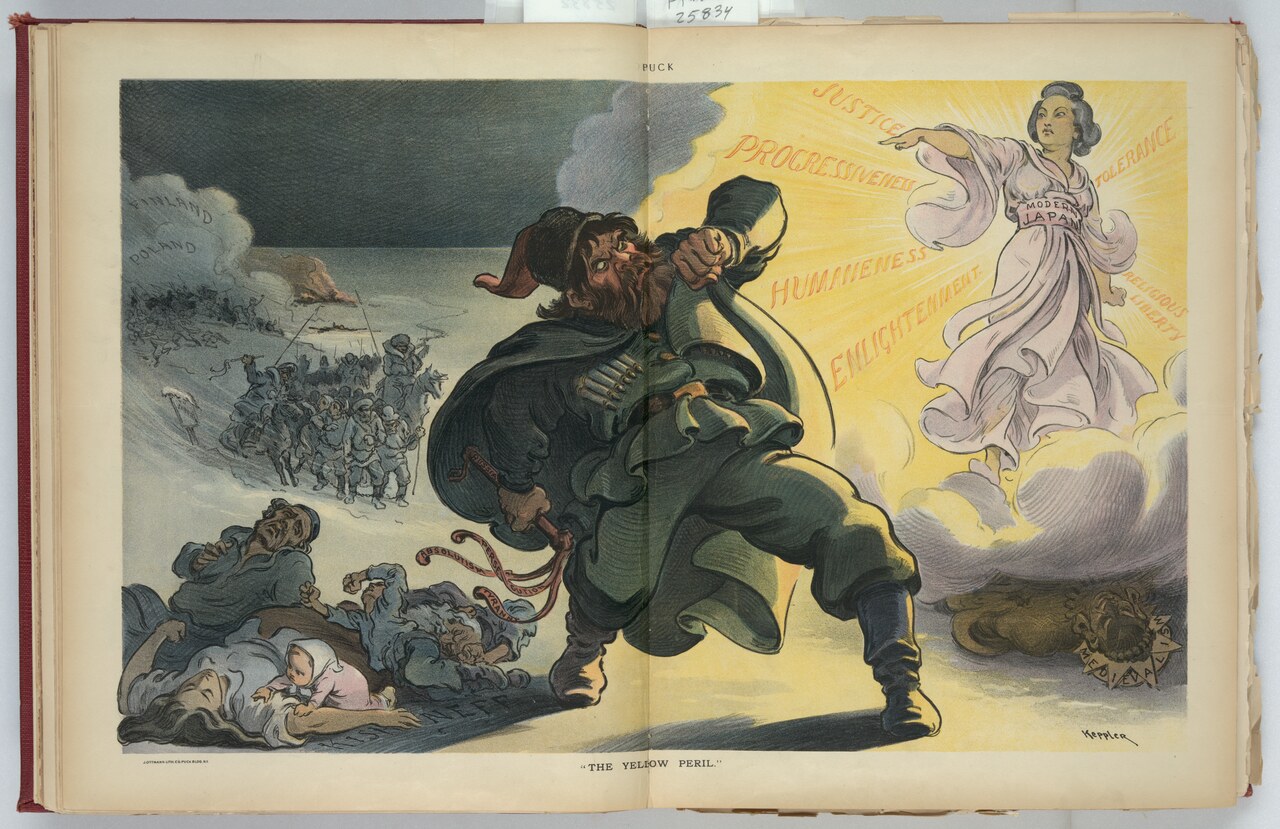
Puck's 1904 centerfold "The Yellow Peril": Russia with a whip over bodies marked "Kishineff," shielding his eyes from a radiant "Modern Japan."
Techniques named on the archive record
Name-callingGlittering generalities
Date
March 23, 1904
Made by
Puck magazine (Keppler & Schwarzmann); drawn by Keppler
Medium
Cartoon
Country
United States
Regime
Theodore Roosevelt Administration
Source
Identified Openly sourced: the speaker is who they say they are
Source
Library of Congress, Prints and Photographs Division , retrieved October 2, 2026
Source
Public domain (published in the U.S. in 1904; LOC: no known restrictions on publication) Keppler, "The Yellow Peril", Puck v. 55 no. 1412, 23 March 1904, centerfold (Keppler & Schwarzmann); LC-DIG-ppmsca-25833
Object, image, and catalog record from the FRAME archive. Text on this page is CC BY 4.0. Image rights are as the archive records.
Keppler's Puck centerfold of 23 March 1904, titled "The Yellow Peril," sets a whip-holding Russia over bodies marked "Kishineff" and has him shield his eyes from a radiant "Modern Japan" ringed with words such as Justice, Tolerance and Religious Liberty.
Content note: the cartoon shows the bodies of pogrom victims, labelled "Kishineff," beneath a figure with a whip; the image is unaltered.
A phrase reversed
The archive describes this centerfold as one that turns the phrase "yellow peril" on Russia. Puck printed it on 23 March 1904, and the record files it under the Russo-Japanese War. The archive describes a bearded figure with a sash reading "RUSSIA" and a whip whose lashes are labelled "ABSOLUTISM," "PERSECUTION" and "TYRANNY." He stands over bodies marked "KISHINEFF" and shields his eyes from a radiant woman whose sash reads "MODERN JAPAN."
PUCK.
[cloud, upper left] FINLAND · POLAND
[ground beside the bodies] KISHINEFF
[sash on the Russian figure] RUSSIA
[ribbons on the whip lashes] ABSOLUTISM · PERSECUTION · TYRANNY
[sash on the radiant woman] MODERN JAPAN
[words in the light, left to right and around her] JUSTICE · PROGRESSIVENESS · HUMANENESS · ENLIGHTENMENT · TOLERANCE · RELIGIOUS LIBERTY
[star-shaped badge on the crushed figure, lower right] MEDIAEVALISM
[signature, lower right] KEPPLER
"THE YELLOW PERIL."
Two sets of words
The cartoon is built from labels. Six labels surround Japan: justice, progressiveness, humaneness, enlightenment, tolerance and religious liberty. Three hang from Russia's whip. A badge on a crushed figure at lower right reads "MEDIAEVALISM." "FINLAND" and "POLAND" float in a cloud at upper left. The archive tags glittering generalities and name-calling and sums up the method: virtue words are attached to one belligerent and abuse words to the other.
The "KISHINEFF" label points to a real atrocity: the archive's content note identifies the bodies as pogrom victims. Most of the rest is assertion. Japan's side of the picture is made of virtue words, and a reader is invited to take a side in a war on the strength of six labels.
How the picture changed
Three years later, Puck's cover As to Japanese Exclusion argued against keeping Japanese immigrants out. By 1912, T. E. Powers drew a Japanese soldier found under a fisherman's sombrero at Magdalena Bay in Keep Off! Monroe Doctrine. The same country could be drawn as radiant or as a threat hiding in Mexico, depending on the cartoonist and the year. Puck's sarcasm about another power is also on this site in British Benevolence of 1882.
Sources
FRAME object record, "The Yellow Peril" (Puck, 1904). Puck, v. 55 no. 1412, 23 March 1904, centerfold (Keppler & Schwarzmann); drawn by Keppler.
Library of Congress, Prints and Photographs Division, LC-DIG-ppmsca-25833, catalog record, retrieved by the archive 2 October 2026. Rights as recorded: public domain (published in the U.S. in 1904); LOC: no known restrictions on publication.