Apollo 11's return trip on a Vietnamese-language fold-out from Saigon, 1969
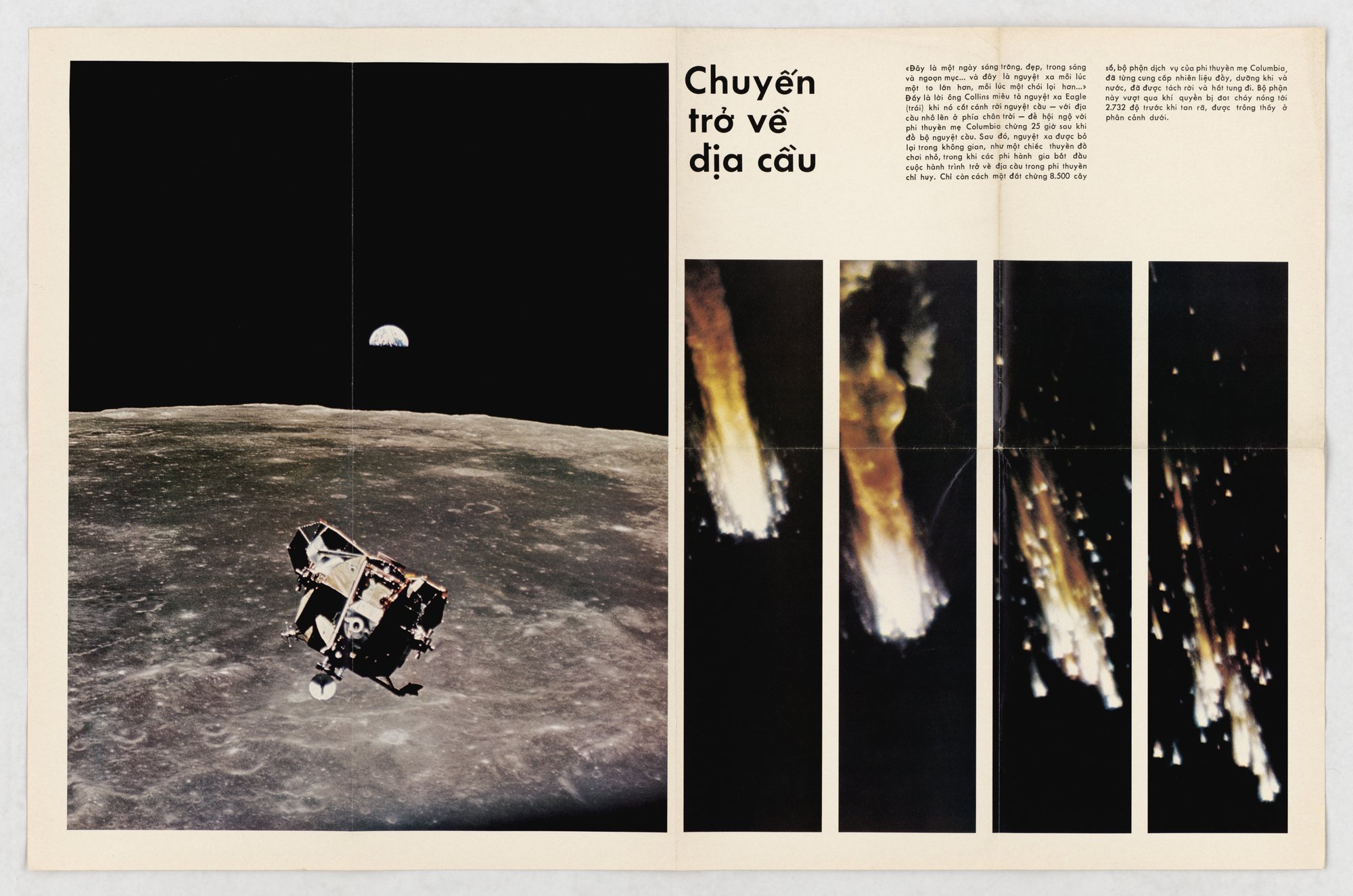
A 1969 Vietnamese-language Apollo 11 fold-out, "Return trip to Earth," quoting Collins on the lunar module Eagle. NARA series credits JUSPAO.
Techniques named on the archive record
Transfer
Date
1969
Made by
Issuer not printed; National Archives series credits JUSPAO, Saigon (U.S. Mission, Vietnam)
Medium
Poster
Country
United States
Regime
Johnson Administration
NARA
NAID 561393
Source
Identified Openly sourced: the speaker is who they say they are
Source
U.S. National Archives (NARA), RG 306, Psychological Warfare Posters, Vietnam War (NAID 561393) , retrieved October 3, 2026
Source
NARA Unrestricted; hosted by owner decision Issuer not printed; National Archives series credits JUSPAO, Saigon (U.S. Mission, Vietnam). National Archives and Records Administration, 306-VP-010-5.
Object, image, and catalog record from the FRAME archive. Text on this page is CC BY 4.0. Image rights are as the archive records.
A 1969 Vietnamese-language fold-out titled "Return trip to Earth" pairs a color photograph of a spacecraft over the Moon, with Earth on the horizon, with frames of a module burning up on reentry, and quotes astronaut Collins on the lunar module Eagle. The National Archives series credits JUSPAO, Saigon.
What it shows
A large color photograph shows a spacecraft above the gray lunar surface, with Earth rising at the horizon. A strip of four tall frames shows a module glowing and breaking apart. A short block of Vietnamese text tells the last part of the mission and quotes Michael Collins.
Chuyến trở về địa cầu
«Đây là một ngày sáng trăng, đẹp, trong sáng và ngoạn mục... và đây là nguyệt xa mỗi lúc một to lớn hơn, mỗi lúc một chói lọi hơn...»
The rest of the text, in FRAME's rendering, says Collins was describing Eagle as it lifted off the Moon to rejoin the command ship Columbia about 25 hours after the landing, that the lunar module was then left in space "like a small toy boat," and that the service module was cast off about 8,500 kilometers from Earth and burned up in the atmosphere, as the lower frames show. The figure of 2,732 degrees is printed without a unit.
Who made it
The sheet prints no issuer. The National Archives keeps it in the Psychological Warfare Posters series of Record Group 306, NAID 561393, item 306-VP-010-5, and credits that series to JUSPAO in Saigon, the U.S. Mission's public affairs office. FRAME files it under the Johnson administration and gives the year only. Apollo 11 itself flew in the summer of 1969, after Johnson had left office in January. This page reports the catalog's tag as given and notes the mismatch.
How to read it
There is no argument on the page. Nothing mentions the war, communism, or the government of South Vietnam. FRAME's reading is transfer: the prestige of the Moon landing is lent to whoever handed out the sheet, in a country at war, by an office whose other posters in the same series do argue about the war.
That is a soft form of propaganda, and it rests on something real. Apollo 11 was an achievement of the American people, their engineers, and their taxes, done in the open with the world watching. A poster that simply shows it is closer to news than to persuasion. The fair criticism is about context, not content: the same office that printed this also printed atrocity posters and enemy-defection appeals, and the wonder was part of the same campaign.
FRAME object record, Return Trip to Earth, 1969. Issuer not printed; National Archives series credits JUSPAO, Saigon. National Archives, RG 306, Psychological Warfare Posters, Vietnam War (NAID 561393), 306-VP-010-5, retrieved 3 October 2026. Rights as recorded: NARA Unrestricted.