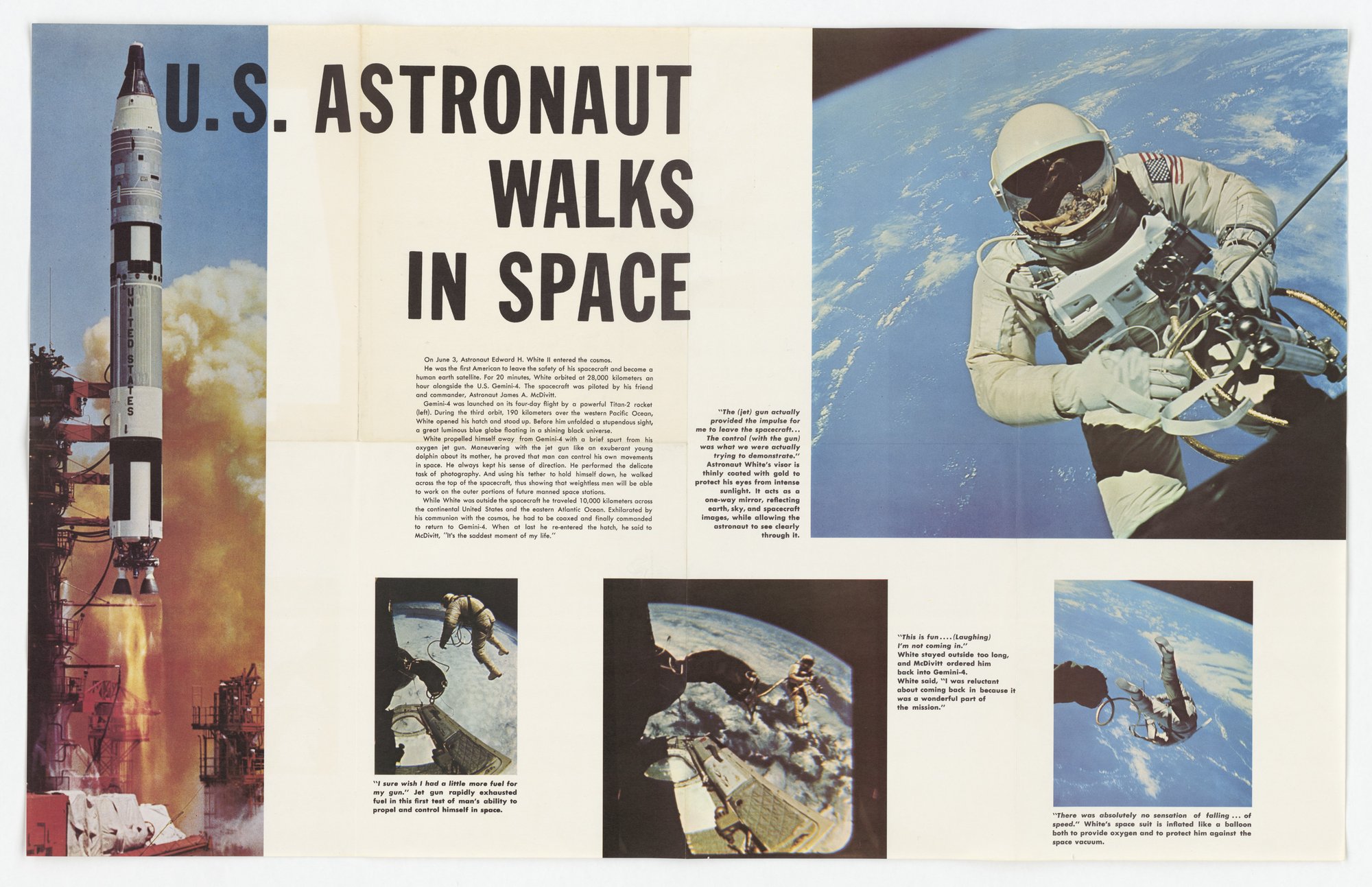
USIA poster 65-360, dated 30 July 1965 and distributed in English in Beirut, tells the story of Edward H. White II's 3 June 1965 spacewalk from Gemini-4 in photographs and his own quoted remarks, ending with his words "It's the saddest moment of my life."
The sheet
A Titan-2 rocket lifting off runs up the left edge. A large color photograph of White, tethered, floating over the Earth, fills the upper right. Three smaller frames below carry short quotations from him, each with a caption. The main text tells the flight in order: launch, the third orbit, the hatch opening, twenty minutes outside, and an order to come back in.
U.S. ASTRONAUT WALKS IN SPACE
On June 3, Astronaut Edward H. White II entered the cosmos. He was the first American to leave the safety of his spacecraft and become a human earth satellite.
[…]
"This is fun.... (Laughing) I'm not coming in." White stayed outside too long, and McDivitt ordered him back into Gemini-4.
[…]
"There was absolutely no sensation of falling ... of speed."
Issuer and audience
The U.S. Information Agency printed it in the National Archives series of posters distributed in Asia, Latin America, and the Middle East. This is the English edition numbered 65-360 for Beirut. FRAME also holds French and Arabic editions of the same sheet, 65-361 and 65-362, and a further Beirut version, 65-363.
How to read it
The archive tags it testimonial and card stacking. White's own words carry the story, which makes it vivid and hard to argue with. The selection is a single success. The sheet says plainly that he "was the first American" to leave his craft; it does not say who had done it first. The omission lets an American achievement stand alone on the page in a race that had two runners.
The poster is otherwise unusually honest about its own story. It prints that White stayed outside too long, that his jet gun ran out of fuel quickly, and that he had to be ordered back. Those are not the details a pure boast would keep. An agency showing its astronaut laughing and reluctant to come in is, on its own, making an argument about what kind of country sent him up. The record does not say whether that was the aim.
Space was a theme USIA returned to. The Vietnamese-language Return Trip to Earth used Apollo 11 the same way four years later. The same agency's Kennedy film poster went to Beirut the year before.
Record and rights
National Archives, Record Group 306, NAID 6949172, item 306-PPB-248, retrieved 4 October 2026. Public domain as a U.S. government work.
Sources
- FRAME object record, U.S. Astronaut Walks in Space poster, 65-360 (English poster distributed in Beirut), 30 July 1965. U.S. Information Agency. National Archives, RG 306, NAID 6949172 (306-PPB-248), retrieved 4 October 2026.