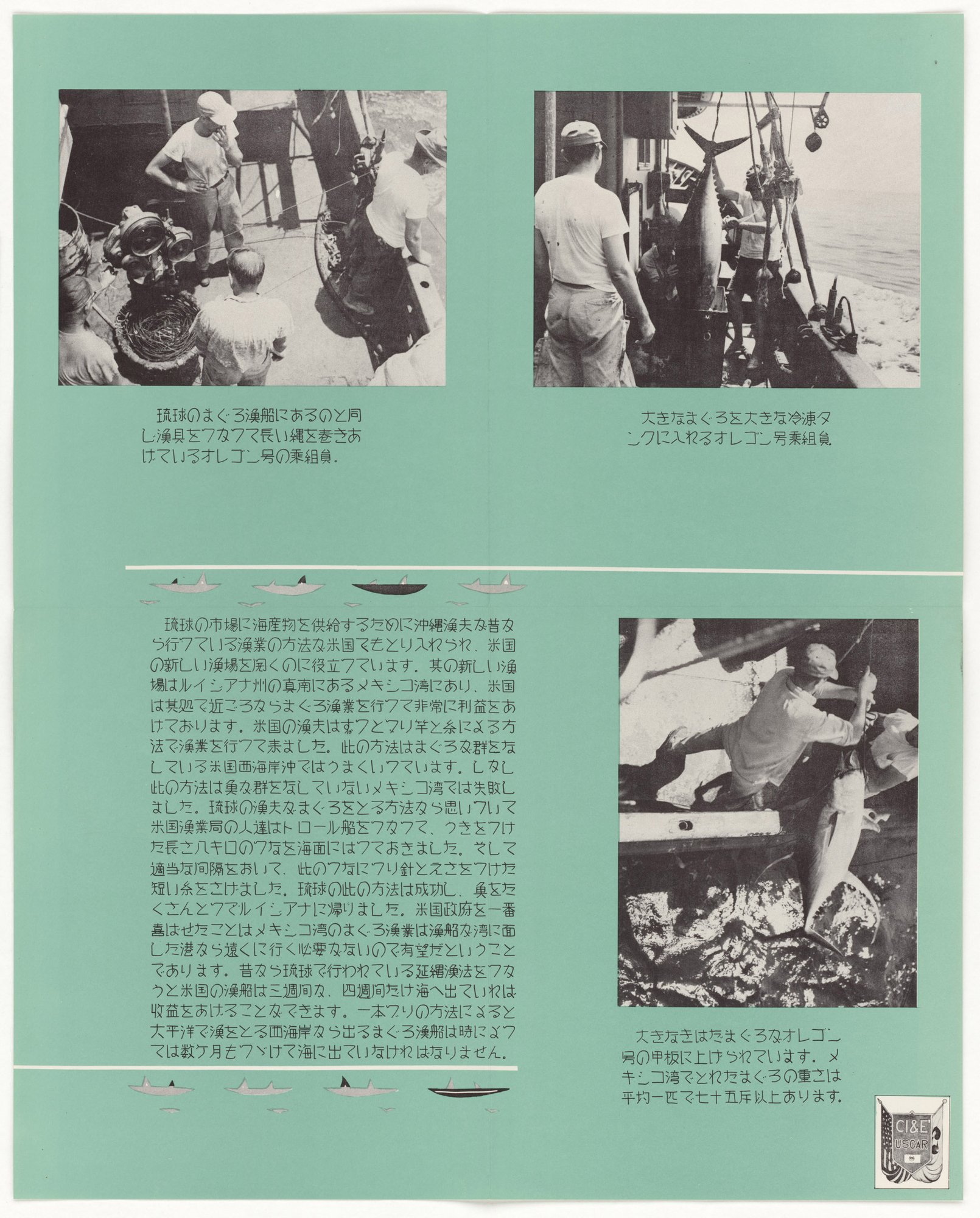
A green Japanese-language photo sheet with a CI&E USCAR badge, distributed in the Ryukyu Islands and filed with U.S. Information Agency posters for Asia. Three photographs of the U.S. trawler Oregon's crew hauling long-line gear and tuna sit beside a text crediting Okinawan fishermen's method with a new Gulf of Mexico tuna fishery (NAID 5730123).
A method borrowed from Okinawa
This sheet tells Okinawan readers that American fishermen learned something from them. The archive describes a green sheet with three photographs of the crew of the U.S. trawler Oregon handling long-line gear and hoisting tuna, under a badge reading CI&E USCAR. The long caption says American rod-and-line fishing failed in the Gulf of Mexico, where the fish do not school, and that a Ryukyuan method succeeded.
琉球の市場に海産物を供給するために沖縄漁夫が昔から行つている漁業の方法が米国でもとり入れられ、米国の新しい漁場を開くのに役立つています。[...]
大きなきはだまぐろがオレゴン号の甲板に上げられています。[...]
[badge:] CI&E USCAR
The archive's English rendering, which it labels a machine translation not verified by a fluent reader, gives the first sentence as "The fishing methods that Okinawan fishermen have long practised to supply the Ryukyu market with seafood have also been adopted in the United States and are helping open up a new American fishing ground." The archive adds that the display typeface makes small and large kana hard to tell apart, so its reading is the best available from the image.
Who put the badge on it
The maker line reads "CI&E, U.S. Civil Administration of the Ryukyu Islands (USCAR), per badge," and the National Archives files the sheet in Record Group 306 with the agency's posters distributed in Asia. The date field reads 1950; the rights line gives "c. 1950-55." FRAME classes the source as identified, since the badge names the office. Audience is recorded as foreign public, purpose as "Persuade or win support," and the themes as economy and finance, and empire and colonialism.
Reading the compliment
FRAME tags the sheet plain folks and transfer. American and Okinawan fishermen are shown at the same craft, and credit for an American profit flows back to the islands. The sheet asks nothing of its readers. It flatters them.
The empire theme in the record matters here. By its own name, USCAR was the U.S. civil administration of the islands, so the badge belongs to the office that ran the place the readers lived in. A compliment from that office is still a compliment, and the fishing account may be accurate. The reader should simply know who is paying it. Here the administration chose to address Ryukyuans as skilled fishermen whose method worked where the American one failed.
The wider program is described on the USIA posters abroad hub. Another Japanese-language sheet from the same Asian files, a U.N. Day poster on cattle vaccine, shows two men in white coats treating a cow.
Sources
- FRAME object record, Oregon tuna long-line photo sheet (Japanese-language poster distributed in the Ryukyu Islands). Maker line: CI&E, U.S. Civil Administration of the Ryukyu Islands (USCAR), per badge. Dated 1950; rights line c. 1950-55.
- U.S. National Archives, Record Group 306, Propaganda Posters Distributed in Asia, NAID 5730123, 306-PPA-225, catalog record, retrieved by the archive October 3, 2026. Rights as recorded: public domain (U.S. government work).