"A Sacrifice to Aguinaldo's Ambition" (commercial stereograph, 1899)
A Sacrifice to Aguinaldo's Ambition: an 1899 stereograph of the Filipino dead at Malabon
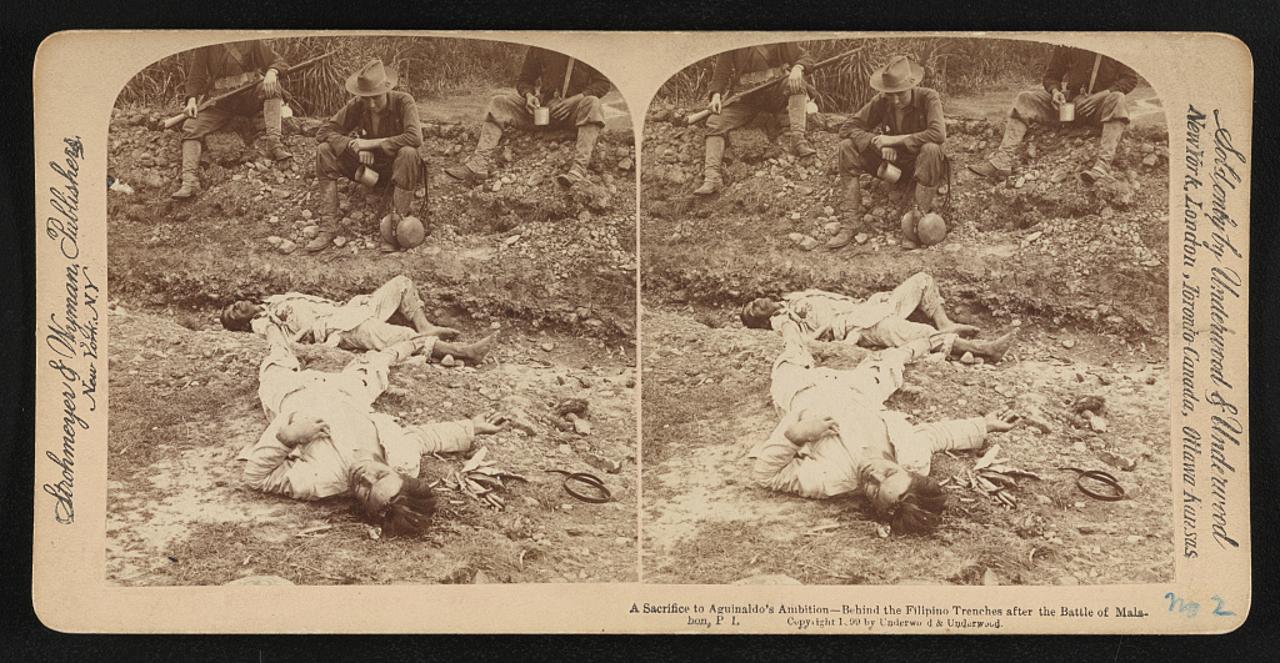
An 1899 Underwood & Underwood stereograph of two dead Filipino soldiers at Malabon, captioned "A Sacrifice to Aguinaldo's Ambition." What the caption does.
Library of Congress, Prints and Photographs Division , retrieved September 27, 2026
Source
Public domain (published in the U.S. in 1899; LOC: no known restrictions on publication) Underwood & Underwood (Strohmeyer & Wyman, publishers), "A Sacrifice to Aguinaldo's Ambition - Behind the Filipino Trenches after the Battle of Malabon, P.I.", stereograph, 1899; LC-DIG-stereo-1s48247
Object, image, and catalog record from the FRAME archive. Text on this page is CC BY 4.0. Image rights are as the archive records.
An 1899 commercial stereograph sold by Underwood & Underwood shows two dead Filipino soldiers behind their trenches after the Battle of Malabon. Its caption, "A Sacrifice to Aguinaldo's Ambition," lays their deaths on the opposing commander rather than on the war.
Content note: the card is a photograph of two dead soldiers, which the archive presents in its published form.
The card
The archive describes a stereograph as two near-identical side-by-side photographs. This one, copyrighted in 1899, shows two dead Filipino soldiers behind their own trenches after the Battle of Malabon, during the Philippine-American War. The archive describes it as a commercial card sold to American households. The printed lines along the margins and the caption along the bottom are all the text it carries.
Strohmeyer & Wyman, Publishers, New York, N.Y.
Sold only by Underwood & Underwood, New York, London, Toronto Canada, Ottawa Kansas.
A Sacrifice to Aguinaldo's Ambition—Behind the Filipino Trenches after the Battle of Malabon, P. I. Copyright 1899 by Underwood & Underwood.
The caption does the work
The photograph shows two men dead in a trench. The caption decides what they mean. "A Sacrifice to Aguinaldo's Ambition" assigns their deaths to one man, the Filipino commander, and to one motive. It does not say who fired, and it does not present them, in the archive's phrase, as "a battlefield loss in a war both sides were fighting."
The archive tags two techniques. Card stacking is the choice of picture and caption together, which, in the record's words, places responsibility for the dead on one man rather than on the war itself. Name-calling is the single loaded word "ambition," attached to the opposing leader. Nothing on the card argues the point; the caption simply states it.
Americans at home were entitled to weigh the war for themselves. A commercial photograph that framed enemy dead as the price of one man's ambition handed its buyers a conclusion instead. The record does not show how many cards sold or what buyers made of them.
Who made it
The card names Strohmeyer & Wyman of New York as publishers and says it was "Sold only by Underwood & Underwood," and lists New York, London, Toronto Canada and Ottawa Kansas. The archive's issuer type is "Corporation." Its source tag is "Unidentified," which the record glosses as "Source blurred: contractors, cutouts, buried disclosure."
The wider propaganda of the war is in the benevolent assimilation case study. A printed view of the same year is School Begins, Puck's January 1899 centerfold of Uncle Sam teaching new territories.
Sources
FRAME object record, "A Sacrifice to Aguinaldo's Ambition" (commercial stereograph, 1899). Underwood & Underwood (Strohmeyer & Wyman, publishers).
Library of Congress, Prints and Photographs Division, LC-DIG-stereo-1s48247, catalog record, retrieved by the archive 27 September 2026. Rights as recorded: public domain (published in the U.S. in 1899); LOC: no known restrictions on publication.