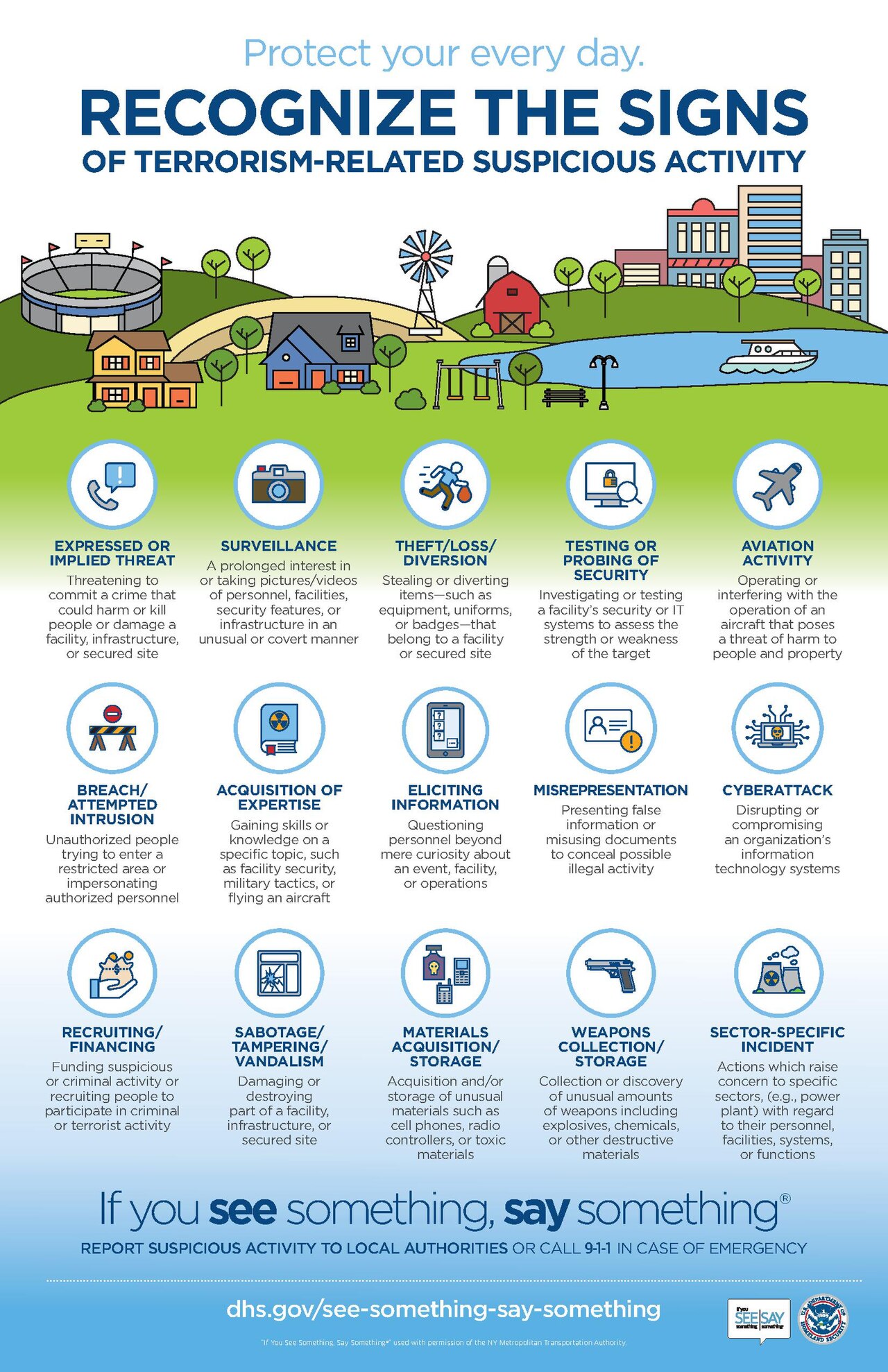
A 2018 poster from the Department of Homeland Security's "If You See Something, Say Something" campaign sets a cheerful scene of homes, a stadium, a farm and a marina under "Protect your every day," then lists fifteen signs of "terrorism-related suspicious activity," from threats and theft to "acquisition of expertise," and asks readers to report to local authorities.
The list
The top of the sheet is a sunny drawing of ordinary places: houses, a stadium, a farm, a marina. Under it run fifteen indicators, each with an icon, a heading and one line of definition. The foot carries the campaign slogan, a reporting instruction and a credit line saying the slogan is used with the permission of New York's Metropolitan Transportation Authority. Four of the fifteen are quoted below.
Protect your every day.
RECOGNIZE THE SIGNS
OF TERRORISM-RELATED SUSPICIOUS ACTIVITY
[...]
SURVEILLANCE
A prolonged interest in or taking pictures/videos of personnel, facilities, security features, or infrastructure in an unusual or covert manner
[...]
ACQUISITION OF EXPERTISE
Gaining skills or knowledge on a specific topic, such as facility security, military tactics, or flying an aircraft
ELICITING INFORMATION
Questioning personnel beyond mere curiosity about an event, facility, or operations
[...]
MATERIALS ACQUISITION/STORAGE
Acquisition and/or storage of unusual materials such as cell phones, radio controllers, or toxic materials
[...]
If you see something, say something®
REPORT SUSPICIOUS ACTIVITY TO LOCAL AUTHORITIES OR CALL 9-1-1 IN CASE OF EMERGENCY
What it asks of a citizen
Several of the fifteen describe crimes on their face: threatening to kill, stealing uniforms, breaking into a restricted area, sabotage. Asking the public to report those is ordinary, and the poster says to call 9-1-1 in an emergency, which is sound advice.
Others describe things a free person may ordinarily do. Taking pictures of a facility is something tourists and hobbyists do. Learning to fly, or studying military tactics, is education. Asking questions "beyond mere curiosity" describes a reporter's job. Keeping cell phones and radio controllers describes many hobbyists. The poster qualifies each with "unusual" or "covert," but it leaves the neighbor holding the phone to decide what is unusual, and it gives no guidance on what happens to the person reported.
The archive tags the poster for fear appeal and card stacking. The scene puts the threat in every ordinary setting, and, as the archive notes, nothing on the sheet says how rare the threat is or what reports lead to.
Who issued it
This is a federal poster, issued by the Department of Homeland Security, and the archive files the issuer type as state and the theme as security and surveillance. The rights line records it as a U.S. government work and notes that the slogan is an MTA trademark. The record does not say where or how widely the poster was displayed.
Earlier DHS messaging includes the five-color threat chart used from 2002 to 2011; later came the 2025 Report All Foreign Invaders poster with an ICE tip line. A 1943 security poster, A Careless Word... Another Cross, asked citizens to watch their own words rather than their neighbors. The Trump administration essay reads the archive's roster for the years this poster falls in.
Sources
- FRAME object record, Recognize the Signs of Terrorism-Related Suspicious Activity ("If You See Something, Say Something"), 2018. U.S. Department of Homeland Security, "If You See Something, Say Something" campaign.
- Wikimedia Commons, DHS_seesomethingsaysomething_indicatorinfographic.pdf, retrieved by the archive 27 September 2026. Rights as recorded: public domain (U.S. government work, per Wikimedia Commons); slogan trademarked by the MTA. Campaign page: dhs.gov/see-something-say-something.