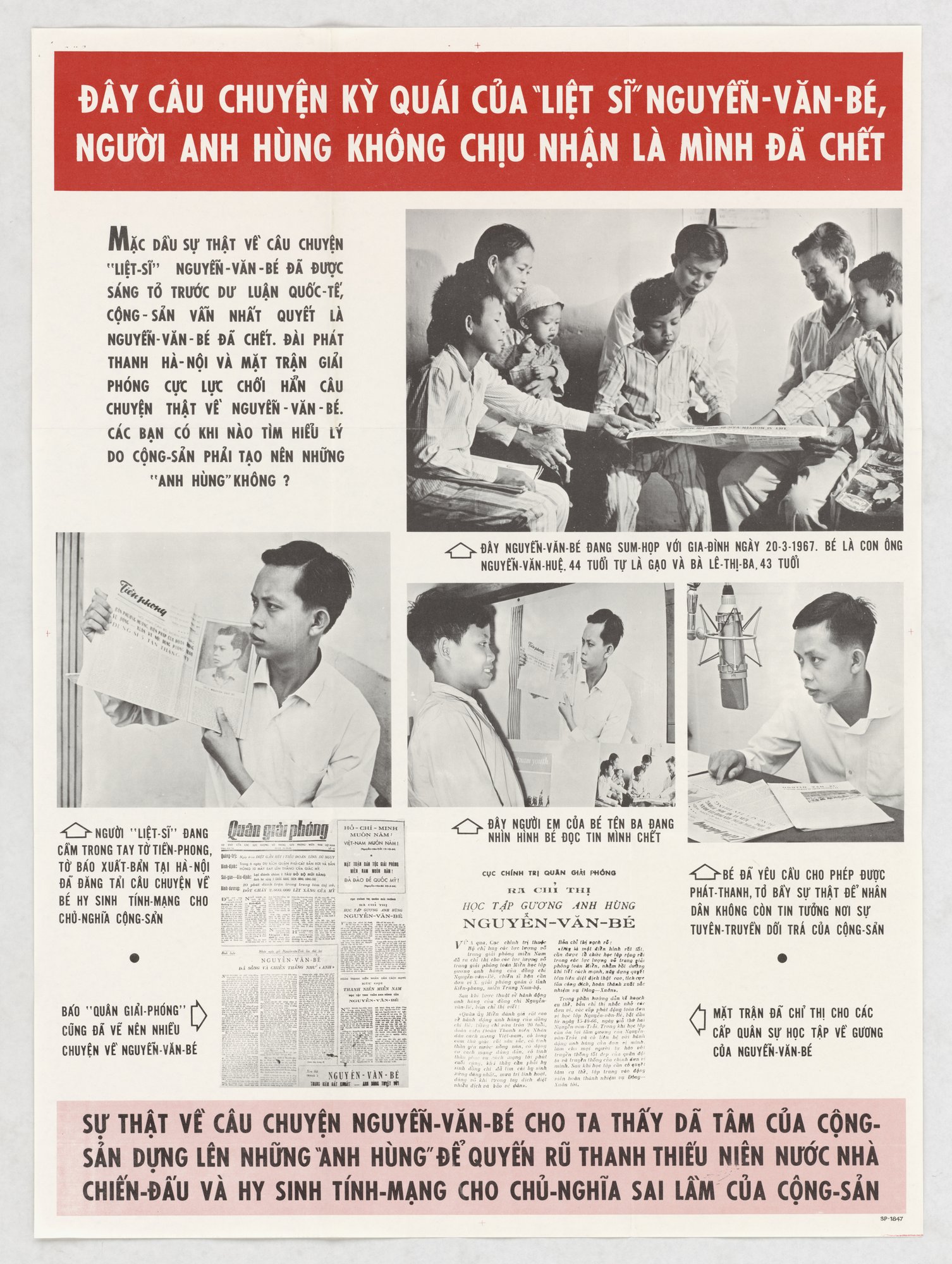
Sheet SP-1847, from 1967, says that Nguyen Van Be, the Viet Cong's "hero" reported dead by the Liberation Front and the Hanoi press, is alive. It shows him with his family on 20 March 1967, holding a copy of the Hanoi paper Tien Phong, and at a radio microphone, beside reproduced Communist newspaper pages.
The claim
The sheet's argument is that the other side invented a martyr. The archive describes it: photographs of Nguyen Van Be with his family on 20 March 1967, Be holding a copy of Tien Phong, and Be at a radio microphone, arranged beside reproduced pages from Communist newspapers. The headline sets the terms.
ĐÂY CÂU CHUYỆN KỲ QUÁI CỦA "LIỆT SĨ" NGUYỄN-VĂN-BÉ,
NGƯỜI ANH HÙNG KHÔNG CHỊU NHẬN LÀ MÌNH ĐÃ CHẾT
[...]
ĐÂY NGUYỄN-VĂN-BÉ ĐANG SUM-HỌP VỚI GIA-ĐÌNH NGÀY 20-3-1967. [...]
[...]
[Reproduced newspaper clippings: masthead "Quân giải phóng"; "CỤC CHÍNH TRỊ QUÂN GIẢI PHÓNG RA CHỈ THỊ HỌC TẬP GƯƠNG ANH HÙNG NGUYỄN-VĂN-BÉ"; "NGUYỄN-VĂN-BÉ ĐÃ SỐNG VÀ CHIẾN THẮNG NHƯ 'ANH'"; body text too small to transcribe]
SP-1847
The archive's English title gives the headline's sense: the strange story of the famous "Late Hero" who refuses to remain dead. Its summary adds that the sheet presents the Liberation Front and the Hanoi press as having reported him dead, and that it accuses the Communists of manufacturing heroes to lure the young. The archive holds other sheets on the same man, among them Nguyen Van Be Still Alive (SP-1983), in which he holds up a Hanoi newspaper that calls him a martyr.
Who printed it
FRAME calls it "South Vietnamese government psychological warfare material, per National Archives series credit to the Joint U.S. Public Affairs Office (JUSPAO) printing section, Saigon," and dates it 1967. The audience is coded "Mixed" and the purpose as persuading or winning support. The source category is "Source blurred: contractors, cutouts, buried disclosure."
Reading it
FRAME's tags are accusation in a mirror, testimonial and card stacking. The testimonial is Be himself, a living man photographed with his family. The card stacking is the selection of clippings.
The first tag deserves the most attention. Accusation in a mirror is charging the other side with the thing you are doing. Here a sheet produced for a psychological warfare program, through an American printing office the sheet does not name, accuses the enemy of producing propaganda. The accusation may well be accurate. If Be was alive while the other side's press reported him dead, that was a real deception, and showing him alive is a fair answer to it. The sheet would be stronger if it told its readers who was making the answer.
Photographic proof of who is alive and who is dead could cut both ways. The 1968 leaflet Lieutenant General Tran Do, alive in the North and dead in the South, relies on a photograph that the archive's source says shows a different person. The Vietnam War messaging hub covers the JUSPAO series.
Sources
- FRAME object record, The Strange Story of the Famous "Late Hero" Nguyen Van Be Who Refuses to Remain Dead, SP-1847, 1967. South Vietnamese government psychological warfare material, per National Archives series credit to the JUSPAO printing section, Saigon.
- U.S. National Archives, Record Group 306, Psychological Warfare Posters, Vietnam War (NAID 561393), catalog record, item 306-VP-5-1847, retrieved by the archive 3 October 2026. Rights as recorded: NARA Unrestricted.
- FRAME object record, Nguyen Van Be Still Alive (Nguyễn-Văn-Bé vẫn còn sống!), SP-1983.