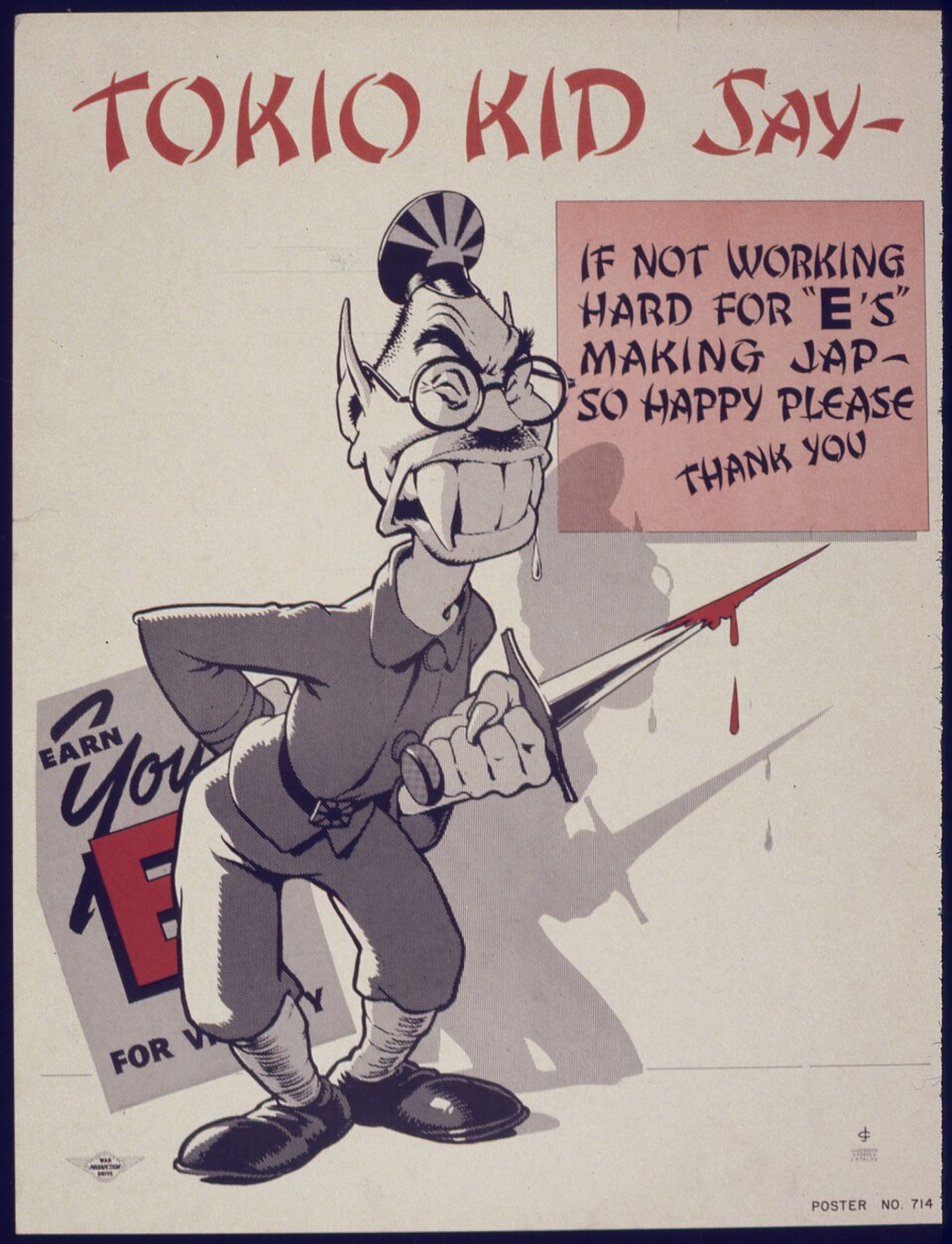
Tokio Kid Say: If Not Working Hard for "E's" (poster no. 714)
Tokio Kid says earn your E, poster no. 714
Tokio Kid poster no. 714 (1942) tells plant workers to earn an E. NARA 534594. The caricature and the slur are the sheet's, quoted here.
Techniques named on the archive record
Name-callingTransfer
Date
1942
Made by
'Tokio Kid' plant-poster series (Douglas Aircraft Company character); small 'War Production Drive' emblem; issuer not otherwise printed
Medium
Poster
Country
United States
Regime
Roosevelt Administration
NARA
NARA 534594
Source
Identified Openly sourced: the speaker is who they say they are
Source
U.S. National Archives and Records Administration (NARA 534594, local id 179-WP-743), via Wikimedia Commons , retrieved October 2, 2026
Source
Public domain in the US (published 1942 without a copyright notice); NARA: No Copyright - United States U.S. National Archives and Records Administration (NARA 534594, 179-WP-743)
Object, image, and catalog record from the FRAME archive. Text on this page is CC BY 4.0. Image rights are as the archive records.
Tokio Kid Say: If Not Working Hard for "E's" is a 1942 poster, number 714, in a plant-poster series whose only printed office mark is a War Production Drive emblem. The figure's line tells workers to earn an E, and says a "Jap" is happy if they do not (NARA 534594).
What the sheet said
Under the words "Tokio Kid say," the picture is a caricature in a rising-sun cap, with a dagger. The speech is the poster's, not a historian's paraphrase. A card behind the figure reads as an instruction to the shop.
TOKIO KID SAY-
IF NOT WORKING HARD FOR "E'S" MAKING JAP- SO HAPPY PLEASE THANK YOU
EARN YOU[R] E FOR V[ICTORY]
POSTER NO. 714
Who printed it
The FRAME tombstone dates the sheet 1942 and describes the maker as the Tokio Kid plant-poster series, a Douglas Aircraft Company character, with a small War Production Drive emblem. It also says the issuer is not otherwise printed. Two sister sheets in the same series do name Douglas Aircraft Company, Inc., Santa Monica: Oh So Joyful for Mishap (NARA 535321, Jack Campbell) and Rivets on Floor, poster no. 812 (NARA 533957). The rights line on this one says public domain in the United States because it was published in 1942 without a copyright notice, and NARA's note is "No Copyright - United States."
A production award is a factory fact. The Army-Navy "E" was a pennant plants hung when a service board accepted their output. Nothing on this sheet explains the award, the inspection, or the contract. It skips to a face and a slur, and it tells the worker that idleness pleases that face.
The Imperial Japanese state was a government at war with the United States. Japanese people are not that government. Japanese Americans are not that government. The poster collapses all three into one grinning thief of the "E." That is the lie in the ink. A foreman could have posted the award rules without drawing an enemy race.
What it was not
This is not a statute and not an exclusion order. No penalty is printed. The coercion, if a worker felt any, sat in the plant and in the wartime production system, not in a jail term named on poster 714. The same year, other offices did use ancestry as a legal category. Those sheets are on the internment-propaganda page. They should not be confused with a shop cartoon, and the shop cartoon should not be excused because it was only a shop cartoon.
Sources
FRAME object record, Tokio Kid Say: If Not Working Hard for "E's" (poster no. 714), 1942. NARA 534594, local id 179-WP-743, via Wikimedia Commons, retrieved by the archive October 2, 2026. Rights as recorded: public domain in the US (published 1942 without a copyright notice); NARA: No Copyright - United States.