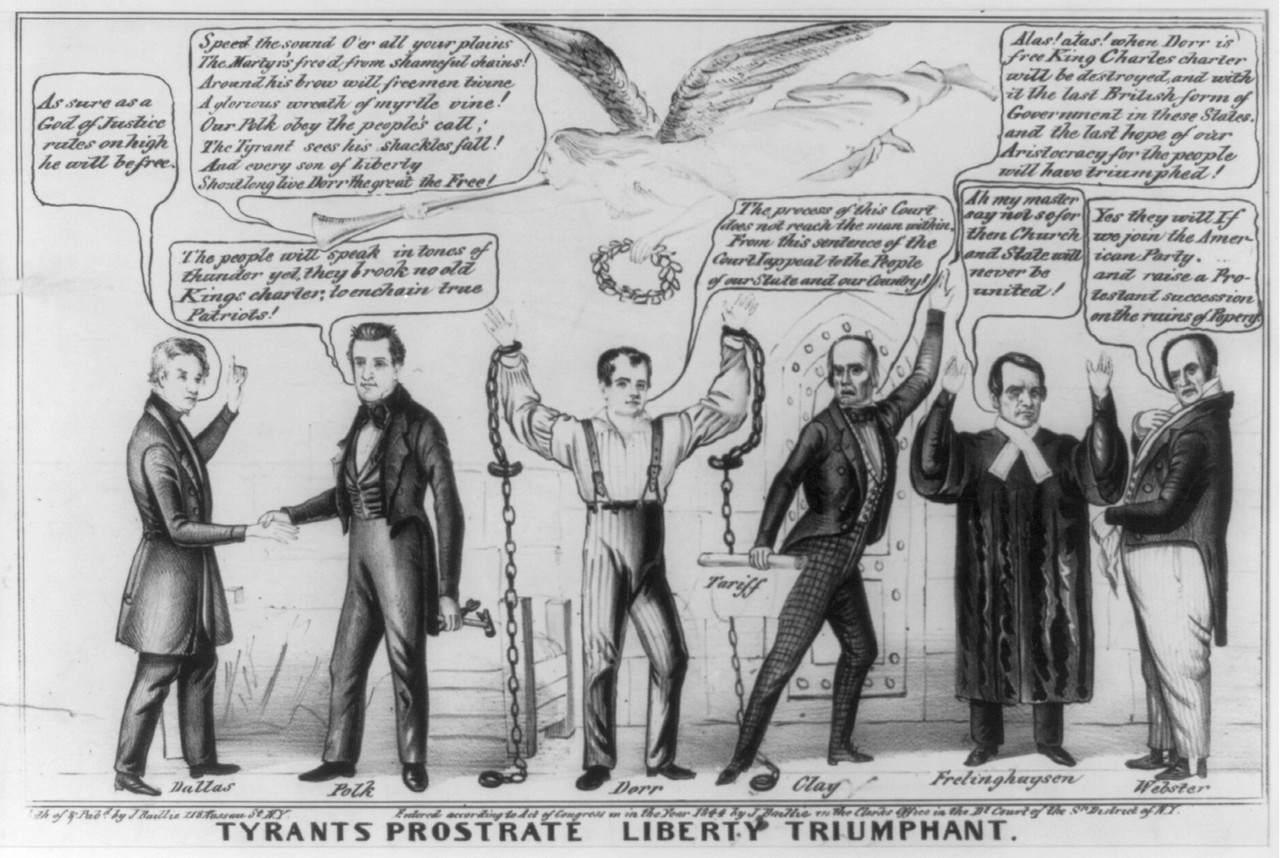
Tyrants Prostrate, Liberty Triumphant (pro-Polk cartoon on Dorr), 1844
Tyrants Prostrate, Liberty Triumphant, the 1844 pro-Polk cartoon in Dorr's cell
Tyrants Prostrate, Liberty Triumphant (1844): Bucholzer and Baillie put Polk beside the jailed Dorr and nativist lines in Whig mouths.
Techniques named on the archive record
Name-callingFear appeal
Date
1844
Made by
Drawn by H. Bucholzer; lithographed and published by James Baillie, New York
Medium
Cartoon
Country
United States
Regime
Tyler Administration
Source
Identified Openly sourced: the speaker is who they say they are
Source
Library of Congress Prints and Photographs Division , retrieved October 2, 2026
Source
Public domain: published 1844, US; LOC rights note: "No known restrictions on publication." Library of Congress, Prints and Photographs Division, Washington, D.C. (item 2008661420)
Object, image, and catalog record from the FRAME archive. Text on this page is CC BY 4.0. Image rights are as the archive records.
An 1844 cartoon drawn by H. Bucholzer and published by James Baillie of New York sets Polk and Dallas beside the chained Thomas Dorr, while Clay, Frelinghuysen and Webster speak of aristocracy and of a Protestant succession "on the ruins of Popery."
In the cell
Content note: the archive records anti-Catholic and nativist wording in the speech balloons, put in the mouths of the Whig figures by a Democratic cartoonist. The quotations keep that wording.
The scene is Thomas Dorr's prison cell. Dorr is in chains. Polk and Dallas clasp hands beside him, an angel with a trumpet sings his release, and on the other side Clay, Frelinghuysen in clerical robes, and Webster speak of what his freedom would cost them. Names are printed beneath all six men.
[Balloon, Dorr:] The process of this Court does not reach the man within, From this sentence of the Court I appeal to the People of our State and our Country!
[Balloon, Clay:] Alas! alas! when Dorr is free King Charles charter will be destroyed, and with it the last British form of Government in these States. and the last hope of our Aristocracy for the people will have triumphed !
[Balloon, Frelinghuysen:] Ah my master say not so for then Church and State will never be united !
[Balloon, Webster:] Yes they will If we join the American Party, and raise a Protestant succession on the ruins of Popery.
[...]
TYRANTS PROSTRATE LIBERTY TRIUMPHANT.
What the cartoon claims
The archive tags it for name-calling and fear appeal. The name-calling is in the title: the Whigs are "Tyrants" and an "Aristocracy," the Democrats are liberty. The fear appeal is the line given to Frelinghuysen and answered by Webster, a plot to unite church and state. No Whig said these words in this cell. They are a Democratic artist's script, and the viewer is meant to take the script as a confession.
Dorr's own balloon is the strongest line on the sheet. He appeals from a court "to the People of our State and our Country," which is a real argument about where authority comes from, and it deserves a hearing on its merits. The cartoon does not give it one. It recruits the appeal to a party ticket and pins religious bigotry on the other side.
That last move cuts two ways. The words themselves are anti-Catholic, and printing them spread them, whoever was meant to be blamed. And putting "the ruins of Popery" in an opponent's mouth, with no source, is a smear. Both are wrong. Twelve years later the insinuation was aimed at a candidate instead: Currier's 1856 Sweepstakes print handed Frémont a cross, which the Library of Congress reads as a hint that he was Catholic.
The same shop, the same year
Bucholzer and Baillie also made Texas Coming In in 1844, which drags Clay into Salt River. The campaign print hub follows the nativist thread through later elections, and the slavery debate case study covers the print war over slavery up to 1860.
Sources
FRAME object record, Tyrants Prostrate, Liberty Triumphant (pro-Polk cartoon on Dorr), 1844. Drawn by H. Bucholzer; lithographed and published by James Baillie, New York.
Library of Congress, Prints and Photographs Division, item 2008661420, catalog record, retrieved by the archive 2 October 2026. Rights as recorded: public domain, published 1844; LOC: "No known restrictions on publication."