Wikimedia Commons (scan via a collector's website) , retrieved October 2, 2026
Source
Public domain (U.S. military/federal work; Commons PD-USGov-Military tag) U.S. military psychological warfare leaflet, Korean War. The Commons file page cites a U.S. federal-employee-work tag; the scan is from a private collector site, and no archive record is cited.
Object, image, and catalog record from the FRAME archive. Text on this page is CC BY 4.0. Image rights are as the archive records.
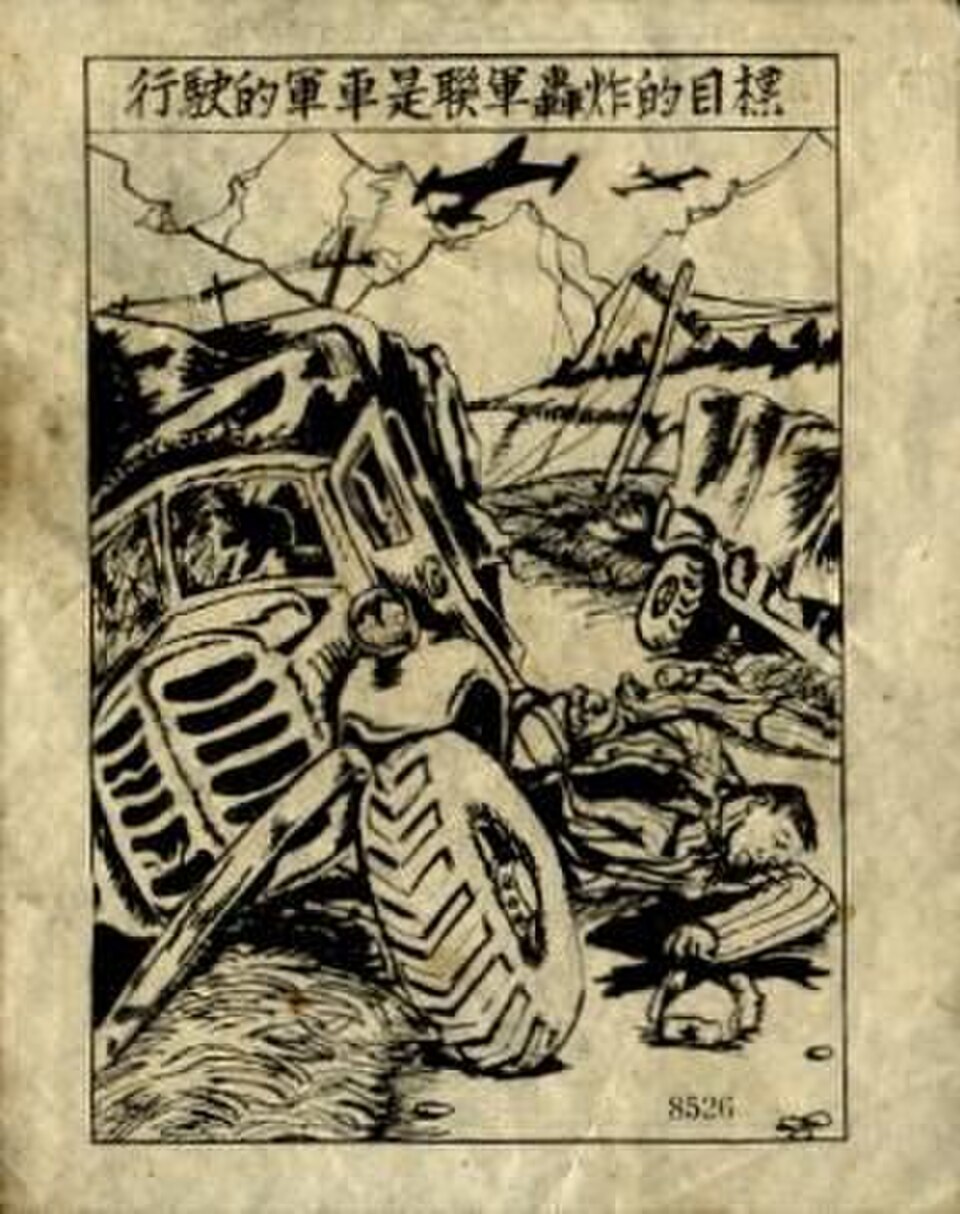
A Chinese-language leaflet, number 8526, dropped on Chinese People's Volunteers in Korea in 1951. The front draws a strafed truck and its dead driver. The back says dozens of vehicles and drivers are destroyed daily, that the reader's position is hopeless, and that thousands who came over are safe and well treated.
Front and back
The front is a line drawing: aircraft overhead, a wrecked truck, a driver dead beside it, and a caption naming moving vehicles as the target of the bombing. The back is all text, four short paragraphs, with the number 8526 printed on both faces.
Moving military vehicles are good targets. Every day dozens of military vehicles, together with their drivers, are destroyed by Allied forces.
The United Nations air force penetrates deep into your rear and stops your food and ammunition from being carried to the front.
Your situation is hopeless day by day. This is one of the reasons you should surrender. Follow the example of the thousands upon thousands of comrades who have already come over to us. Here they are not only safe in life but also enjoy good treatment.
Who issued it
The leaflet names "the United Nations air force" as the attacker but names no office as the author. FRAME attributes it to the U.S.-led United Nations Command's psychological warfare effort in Korea and classes the source as blurred. The scan reached Wikimedia Commons from a private collector's site, and the Commons page tags it as a federal work in the public domain; FRAME notes that no archive holding is cited for it.
How to read it
The sheet is built in two moves. First it threatens a specific job: the truck driver, the man on the supply road. Then it offers a way out and a reason to believe the way out is real, which is the crowd that has supposedly gone before. FRAME tags the first move fear appeal and the second bandwagon.
Two claims carry the weight, and the sheet gives a source for neither. "Dozens" of vehicles a day and "thousands upon thousands" of men who crossed are numbers chosen to persuade, not reported to inform. The promise of good treatment is the claim that matters most to the man reading it, and it is the one he could not check until he had already acted on it.
That is the hard edge of every surrender appeal, and it is why the promise is a moral commitment and not just a tactic. A government that drops "you will be safe" over an enemy army owes the men who believe it exactly that. How the men who answered this leaflet were actually treated is not in any record on this site. The signed version of the same promise is the safe-conduct certificate with Ridgway's printed name; a later sheet on the same supply theme is leaflet 8274. Both sit in the US and UN Command messaging in the Korean War collection.
Sources
FRAME object record, 行駛的軍車是好目標 (Moving Military Vehicles Are Good Targets), leaflet no. 8526, 1951. U.S.-led United Nations Command psychological warfare, Korea.
Wikimedia Commons, File:Korean War US Propaganda Leaflet NO.8526 (front).jpg, scan from a collector's website, retrieved by the archive 2 October 2026. Rights as recorded: public domain (U.S. military/federal work; PD-USGov-Military); no archive record cited.
.jpg)