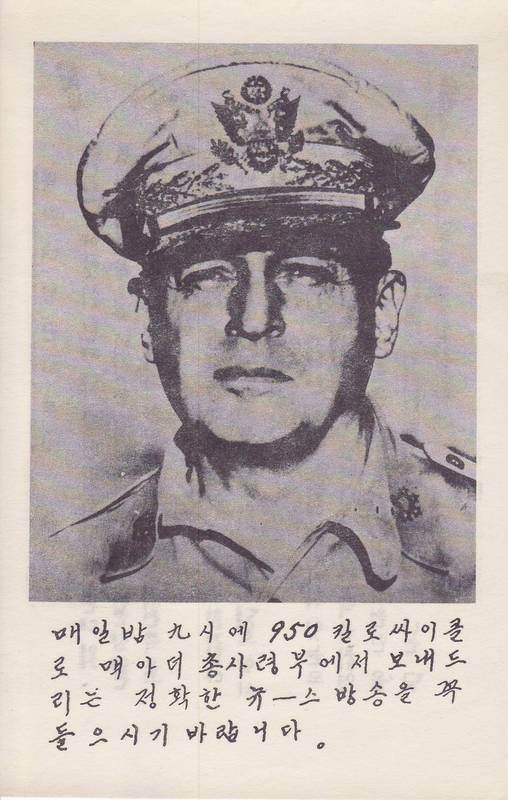
MacArthur's portrait: listen to the news at 9 every night on 950 kilocycles
A 1950 Korean leaflet that put MacArthur's face on a radio schedule
1950 UN Command leaflet in Korean: a portrait of Gen. MacArthur over four lines urging readers to hear his headquarters' news at 9 p.m. on 950 kilocycles.
Techniques named on the archive record
TransferGlittering generalities
Date
1950
Made by
United Nations Command / U.S. Army psychological warfare, Far East Command (General Douglas MacArthur)
Medium
Leaflet
Country
United States
Regime
Truman Administration
Source
Identified Openly sourced: the speaker is who they say they are
Source
Wikimedia Commons , retrieved October 2, 2026
Source
Public domain (U.S. military work, 1950; Commons PD-USGov-Military tag) U.S. Army psychological warfare, Far East Command / United Nations Command; via Wikimedia Commons (File:Korean War US Propaganda Leaflet No.1004 (front).JPG).
Object, image, and catalog record from the FRAME archive. Text on this page is CC BY 4.0. Image rights are as the archive records.
A Korean-language leaflet from the United Nations Command's psychological warfare service in 1950. Nearly the whole sheet is a halftone portrait of General Douglas MacArthur; four short lines under it ask readers to tune to 950 kilocycles at nine every night for news from his headquarters.
The sheet
The general fills the paper: uniform, peaked cap, a photograph reproduced in halftone dots. There is no slogan above him and no cartoon beside him. The text is a single sentence broken over four lines at the foot, and the line breaks fall in the middle of words, as if the lettering was fitted to the space left over.
매일밤 九시에 950 킬로싸이클
로 매아더 총사령부에서 보내드
리는 정확한 뉴-스 방송을 꼭
들으시기 바랍니다.
Who issued it
FRAME credits the United Nations Command and U.S. Army psychological warfare under the Far East Command, and classes the source as openly identified: the sheet names MacArthur's headquarters as the broadcaster. The image is the front of a leaflet that Wikimedia Commons files as Korean War leaflet No. 1004. Only that face is in the record. The rights line records it as public domain, a U.S. military work.
How to read it
This leaflet does not argue. It advertises. Its job was to send the reader to a different medium, the radio, where the argument would be made every night at a fixed hour. In that sense it is a piece of plumbing in a larger campaign, and the record holds only this end of the pipe. What the nine o'clock bulletins said is not in the archive.
FRAME tags it transfer and glittering generalities. Both fit. The sheet offers one reason to trust the broadcast, and it is the commander's face. The one adjective, "accurate," is a promise the paper cannot keep for itself. A listener could only test it against what happened, and the sheet gives him nothing to test it with.
A free reader would ask the same question of any government's news service, including his own: who edits it, and what are they allowed to leave out? The leaflet does not answer, and it does not pretend to be anything other than the commander's channel. That candor about the speaker is worth noting. Many later sheets in the same war printed no issuer at all, like leaflet 7230. The same headquarters signed MacArthur's August 1950 letter on prisoners. The rest of the war's leaflets are gathered under US and UN Command messaging in the Korean War.
Sources
FRAME object record, "MacArthur's portrait: listen to the news at 9 every night on 950 kilocycles," 1950. United Nations Command / U.S. Army psychological warfare, Far East Command (General Douglas MacArthur).
.JPG)