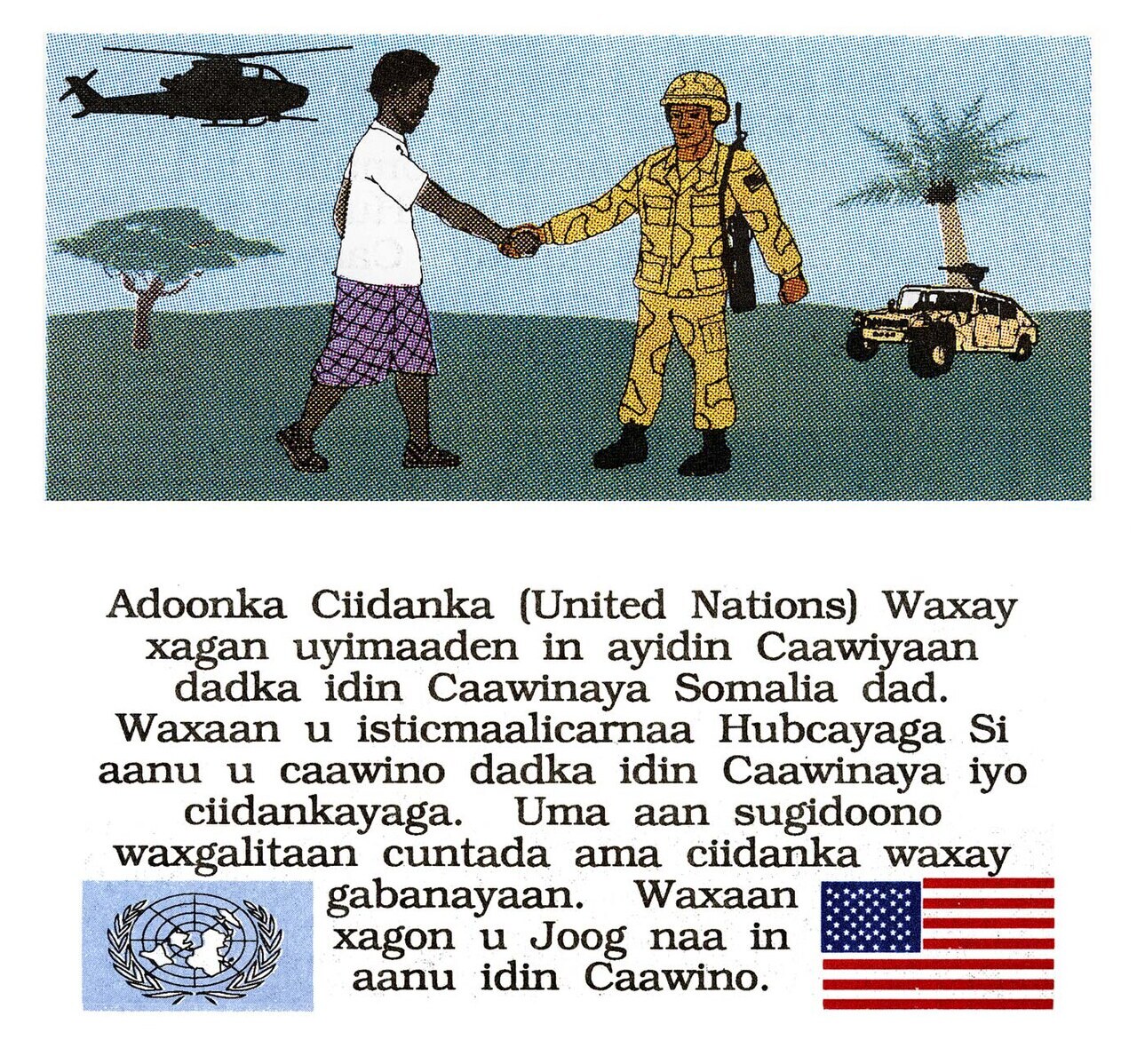
UNITAF handshake leaflet for Somalia (Operation Restore Hope, 1993)
A handshake and the word for help: the UNITAF leaflet for Somalia, 1993
A 1993 UNITAF psychological-operations leaflet for Somalia: a handshake with a U.S. soldier on the front, and on the back a Somali text built on "Caawin,"
Techniques named on the archive record
Glittering generalities
Date
1993
Made by
U.S.-led Unified Task Force (UNITAF) psychological operations, Operation Restore Hope
Medium
Leaflet
Country
United States
Regime
George H. W. Bush Administration
Source
Identified Openly sourced: the speaker is who they say they are
Source
Wikimedia Commons (U.S. Department of Defense / NARA; psywar.org scan) , retrieved October 2, 2026
Source
Public domain (U.S. government work; Commons PD-USGov front, PD-UN-doc back) U.S. Department of Defense (UNITAF psychological operations), 1993; via Wikimedia Commons (reverse: https://commons.wikimedia.org/wiki/File:US_PSYOPS_leaflet_reverse_side,_Operation_Restore_Hope,_Somalia.jpg)
Object, image, and catalog record from the FRAME archive. Text on this page is CC BY 4.0. Image rights are as the archive records.
A two-sided Somali-language leaflet from the U.S.-led Unified Task Force in Operation Restore Hope, 1993. The front shows a Somali man shaking hands with a U.S. soldier; the back sets the UN emblem and the U.S. flag beside a short text built on the verb "Caawin," help.
Front and back
The front has no words. In the archive's description, a Somali man in a white shirt and a checked wrap shakes hands with a U.S. soldier in camouflage, with a Cobra helicopter and a Humvee behind them. The back carries the United Nations emblem, the U.S. flag, and a short paragraph in Somali. The maker is the psychological operations arm of the Unified Task Force, UNITAF, the U.S.-led force of Operation Restore Hope.
[Front: no text.]
[Back:] Adoonka Ciidanka (United Nations) Waxay xagan uyimaaden in ayidin Caawiyaan dadka idin Caawinaya Somalia dad. Waxaan u isticmaalicarnaa Hubcayaga Si aanu u caawino dadka idin Caawinaya iyo ciidankayaga. Uma aan sugidoono waxgalitaan cuntada ama ciidanka waxay gabanayaan. Waxaan xagon u Joog naa in aanu idin Caawino.
What the text says
The archive gives an English rendering, which it labels a machine translation by Claude, not verified by a fluent Somali reader. It calls the rendering literal and approximate and says one clause is unclear and rendered only in part. In that rendering, the troops "have come here to help you," say "We use our weapons so that we can help the people who help you and our troops," and close with "We are here to help you." Every English rendering of the Somali on this page is unverified.
Even in the printed Somali, without a translation, one feature can be checked by eye: forms of "Caawin" recur through the short paragraph. The archive's reading builds on that repetition. Its technique tag is glittering generalities, and its tell is that the assurance is stated only as help and friendship, with no terms, limits or conditions given. The record's purpose field reads "Reassure."
What it leaves out
This is a message from an armed force to a foreign population. In the archive's rendering it says the force's weapons are there to help, and the picture shows a handshake. It does not say how long the troops will stay, what they will and will not do, or whom a Somali reader could hold to account. The record does not show how the leaflet was distributed or how many were printed.
A decade earlier, a U.S. Army handbill in People of Grenada told another population that their Caribbean neighbors, with U.S. support, had come to restore democracy and insure their safety.
Sources
FRAME object record, UNITAF handshake leaflet for Somalia (Operation Restore Hope, 1993). U.S.-led Unified Task Force (UNITAF) psychological operations.
Wikimedia Commons, front and reverse (U.S. Department of Defense / NARA; psywar.org scan), retrieved by the archive 2 October 2026. Rights as recorded: public domain (U.S. government work; Commons PD-USGov front, PD-UN-doc back).