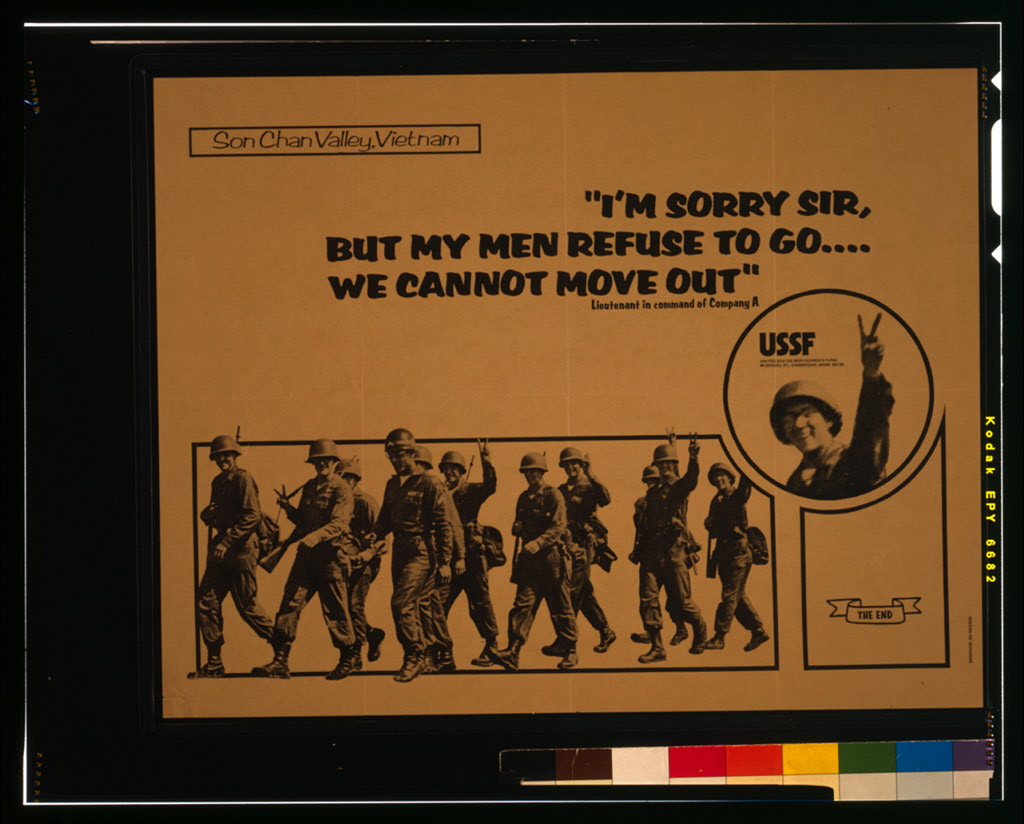
A 1970 poster by the United States Servicemen's Fund of Cambridge, Massachusetts, sets a quotation attributed to an unnamed lieutenant commanding Company A in the Son Chan Valley, "I'm sorry sir, but my men refuse to go," over a photograph of U.S. soldiers on the march.
What the poster shows
A line of American soldiers in helmets walks toward the camera, and some of them are flashing the peace sign. A place name and a quotation sit across the picture, with a rank but no name under it. A round badge carries the sponsor's initials and address, and a banner across the image reads "The End."
Son Chan Valley, Vietnam
"I'M SORRY SIR,
BUT MY MEN REFUSE TO GO....
WE CANNOT MOVE OUT"
Lieutenant in command of Company A
USSF
UNITED STATES SERVICEMEN'S FUND
[street number] SCHOOL ST., CAMBRIDGE, MASS. 02138
THE END
Who printed it
The United States Servicemen's Fund, a private group with a Cambridge, Massachusetts, address, printed its name on the sheet. FRAME classes the source as openly identified. The copy is in the Library of Congress (item 2016648470), recorded as a U.S. publication without a copyright notice.
Reading the quotation
The archive record does not identify the lieutenant, the company's parent unit, or the date, and it does not say whether the photograph shows the men in the quotation. This page does not fill those gaps. What the poster offers is a sentence with a rank attached, and a picture placed under it.
FRAME tags it testimonial and bandwagon. The testimonial is the officer: a man in command, speaking for his men, lends the refusal an authority no civilian could give it. The bandwagon is the photograph: a whole file of soldiers, some making the peace sign, so that one company's refusal looks like an army's mood. "The End" draws the conclusion for the reader.
Two things are true together. Soldiers are citizens, and a private group that speaks to them about the war they are fighting is using the freedom of the press. The Pentagon spoke to the same men, in its own name, with films such as Why Vietnam? And an unnamed quotation is the weakest kind of evidence a poster can carry: it cannot be checked, and it asks to be believed because of who it says spoke. Read it the way this site reads the government's unsigned leaflets, and ask for the name.
The pro-war answer from the same years, also private, is "Tell it to Hanoi". The wider record of the war years is in US Vietnam War messaging, 1954–1975.
Sources
- FRAME object record, Son Chan Valley, Vietnam: "I'm sorry sir, but my men refuse to go," 1970. United States Servicemen's Fund (Cambridge, Massachusetts).
- Library of Congress, Prints and Photographs Division, item 2016648470, retrieved by the archive 2 October 2026. Rights as recorded: U.S. publication without copyright notice; no known restrictions on publication.