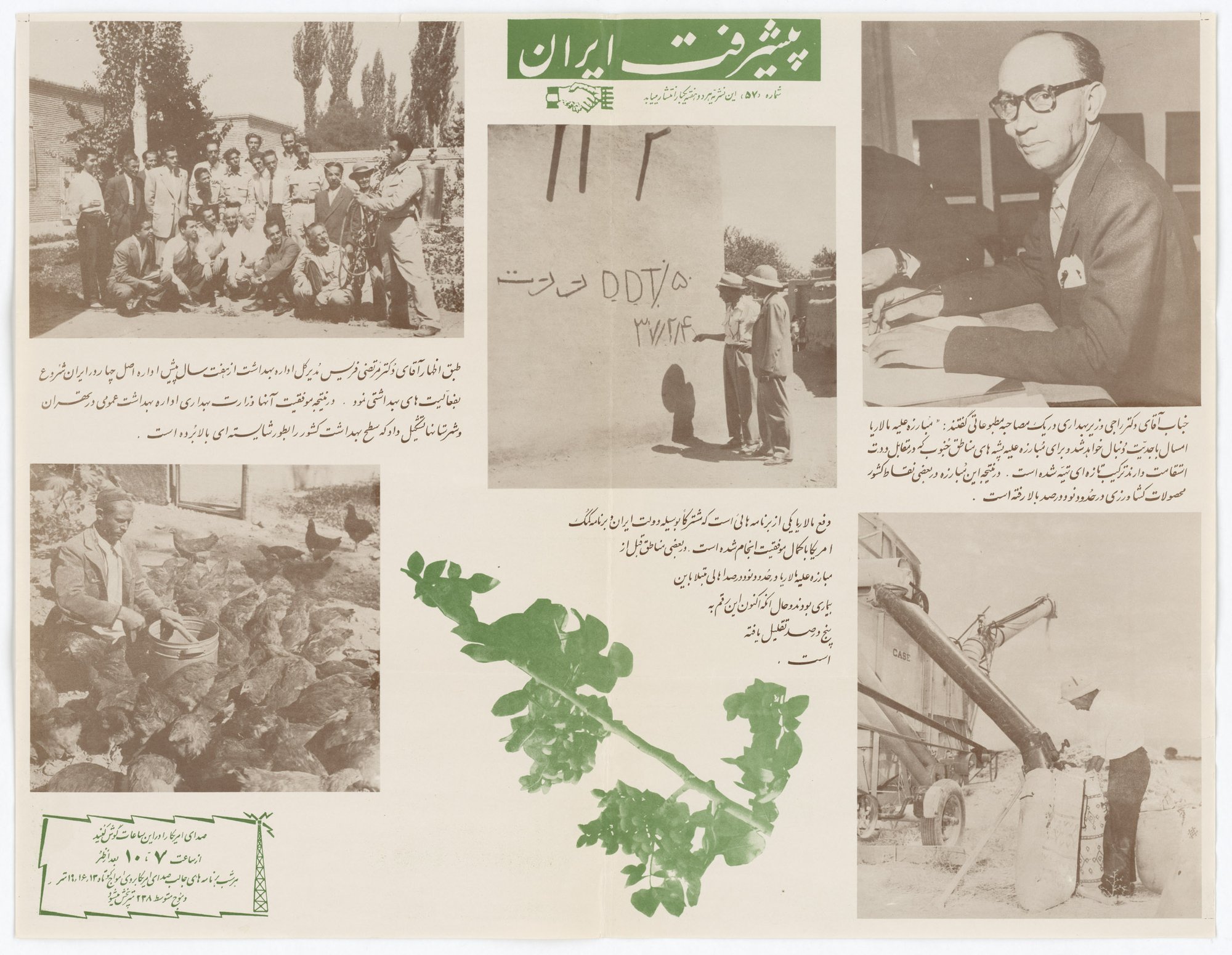
Progress of Iran No. 57, a 1958 USIA wall newspaper on the malaria campaign
A 1958 USIA wall newspaper for Tehran credits Point Four and US aid for malaria control, quotes Iranian officials, and lists Voice of America times.
Techniques named on the archive record
TestimonialCard stacking
Date
July 10, 1958
Made by
U.S. Information Agency (predecessor: State Department International Information and Educational Exchange Program), Propaganda Posters Distributed in Asia, Latin America and the Middle East series
U.S. National Archives (NARA), RG 306, Propaganda Posters Distributed in Asia, Latin America and the Middle East , retrieved October 4, 2026
Source
Public domain (U.S. government work; NARA RG 306) U.S. Information Agency / Department of State, July 10, 1958. National Archives, Record Group 306 (NAID 6948872, 306-PPB-53m).
Object, image, and catalog record from the FRAME archive. Text on this page is CC BY 4.0. Image rights are as the archive records.
A Farsi wall newspaper titled "Progress of Iran," No. 57, catalogued at 10 July 1958 and filed with U.S. Information Agency posters for Tehran. Photographs of DDT spraying sit beside quotations from Iranian health officials and captions crediting Point Four and the American aid program, and a box gives Voice of America listening times.
The page
It is laid out like a newspaper pasted to a wall. Under the masthead "Progress of Iran," a note says the bulletin appears every two weeks. Photographs show a spraying demonstration for health workers, a wall chalked "DDT" with a date, the health minister at his desk, and two farm scenes, poultry and a threshing machine marked CASE. Captions carry the argument.
Malaria control is one of the programmes carried out jointly by the Iranian government and the American aid programme with complete success. Some regions before the malaria campaign had about ninety per cent of people ill with this disease, and now this figure has been reduced to five per cent.
[…]
a new compound has been prepared for the fight against the mosquitoes of the southern regions that resist DDT.
[…]
Listen to the Voice of America at these hours: from 7 to 10 in the evening
In the same rendering, the health department's director general dates the American role to the Point Four office's health work "seven years ago," and the minister of health is quoted in a press interview saying farm output rose about ninety percent in some areas as a result of the campaign.
Who made it
The National Archives keeps the sheet in Record Group 306, Propaganda Posters Distributed in Asia, Latin America and the Middle East, as 306-PPB-53m (NAID 6948872), the U.S. Information Agency's poster file. FRAME's source category is "blurred," meaning the sponsor is not plain to the reader. That fits what the transcription shows: the masthead is Iranian in name and voice, the speakers quoted are Iranian officials, and the American hand appears in the credit to the aid program and in the radio box at the foot.
A success story with one honest line
The archive tags testimonial and card stacking. The testimonials are the ministers'. The stacking is in the selection: every number is a gain, and there is no line on cost, setbacks or how the percentages were measured. Ninety percent ill falling to five is a claim a reader in Tehran had no way to test from the page.
One line cuts against the pattern. The minister is quoted saying southern mosquitoes "resist DDT" and that a new compound has been prepared. A pure advertisement would leave that out.
The anti-malaria work the sheet describes, spraying carried out jointly with the Iranian government, is the kind of foreign aid that is easy to defend. The criticism is about voice. A reader who took this for an Iranian ministry bulletin was reading something an American agency had filed as its own, and apart from a mention of Point Four and a credit to "the American aid programme" inside the captions, the plainest American mark on it was a box advertising American radio.
USIA malaria sheets for other countries, including a Bengali photo poster on the worldwide mosquito campaign the same year, are in US public health messaging, 1917–1969.
Sources
FRAME object record, Wall News poster No. 57, malaria campaign (Farsi, distributed in Tehran), 10 July 1958. U.S. Information Agency. English rendering as given by the archive, labeled machine translation, not verified.
U.S. National Archives, RG 306, Propaganda Posters Distributed in Asia, Latin America and the Middle East, NAID 6948872, local id 306-PPB-53m, catalog record, retrieved by the archive 4 October 2026. Rights as recorded: public domain (U.S. government work).