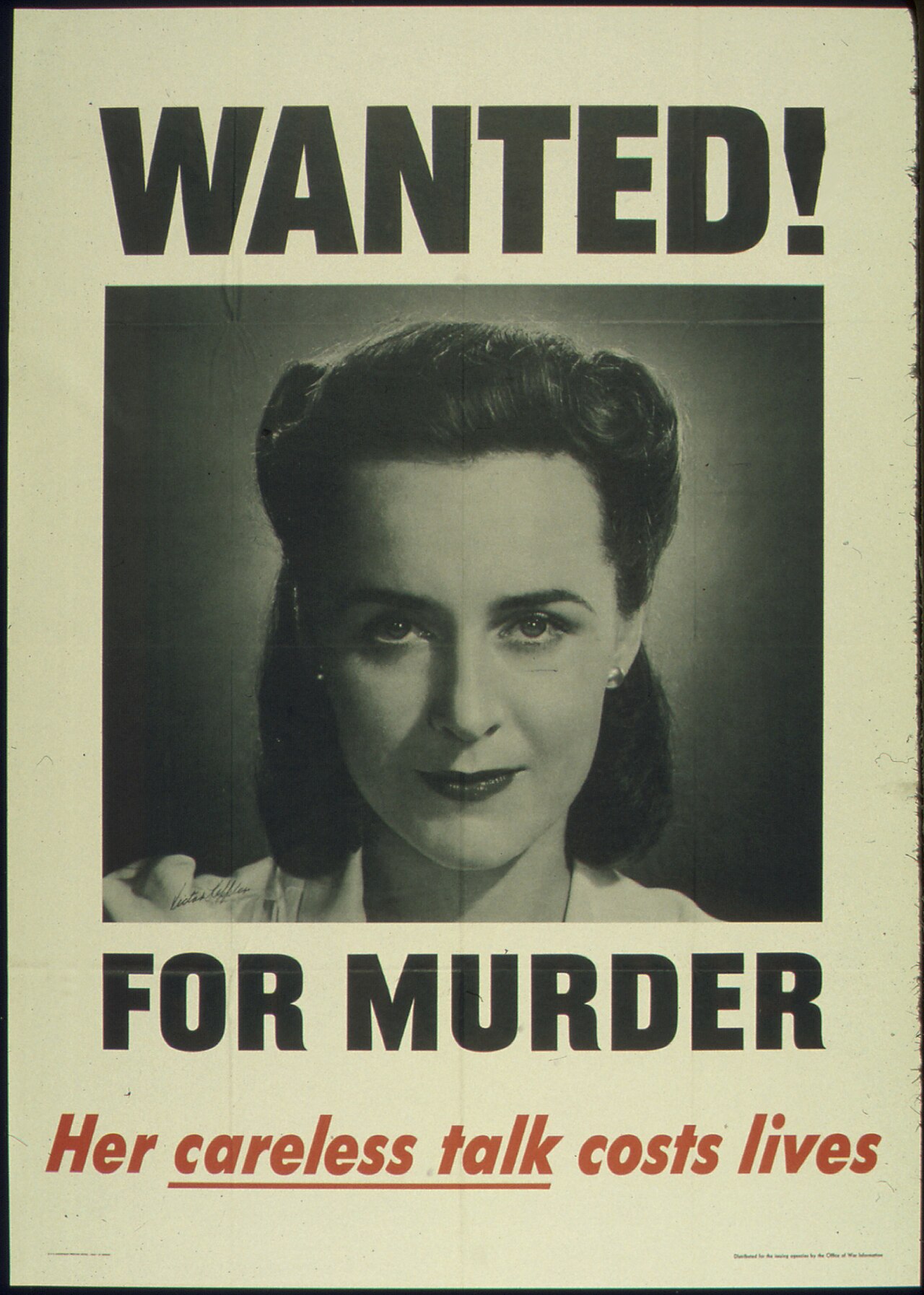
Wanted! For Murder is a 1942 home-front security poster with a photograph by Victor Keppler. It dresses a warning about loose conversation as a wanted notice for an unnamed woman, with drowning soldiers behind her.
What the sheet prints
The layout copies a police notice. A photographed woman, well dressed and made up, looks out from the center. Behind her the picture dissolves into men in the water. Three lines of type do the rest.
WANTED!
FOR MURDER
Her careless talk costs lives
[illegible — small printer's credit, bottom left]
Distributed for the issuing agencies by the Office of War Information
Who made it
The archive's maker line is a U.S. government home-front security campaign, with the photograph by Victor Keppler, dated 1942. The sheet itself says it was distributed by the Office of War Information for "the issuing agencies," without naming them. The image came from Wikimedia Commons on 25 September 2026; the Commons file name ends in NARA 513599, while the FRAME tombstone lists no NAID. The rights line records a public-domain U.S. government work from the National Archives' World War II Posters series.
How to read it
A wanted notice is the state's way of accusing a particular person of a particular crime before a court has ruled. This poster borrows the form and leaves out everything that gives it meaning: there is no named suspect, no act, no ship, no evidence. A woman who talks too much is simply declared a murderer, and the drowning men behind her stand in for proof. The blame lands on one civilian, and on a woman, rather than on the enemy or on anyone who might have kept a secret better.
Wartime secrecy about ship movements was a real need, and asking people to keep quiet about them was reasonable. Calling a citizen a killer for conversation is a different thing. Due process exists because accusation is easy and the state's voice is loud.
The case study A free-speech preamble, then five years in prison cites this poster as a historical echo. Related home-front sheets are He's Watching You and the 1942 Seagram warning. A separate home-front effort against rumor is covered in the rumor clinics case study.
Sources
- FRAME object record, "Wanted! For Murder — Her Careless Talk Costs Lives," 1942. U.S. government home-front security campaign; photograph by Victor Keppler. U.S. National Archives and Records Administration via Wikimedia Commons, retrieved by the archive 25 September 2026. Rights as recorded: public domain (U.S. government work).