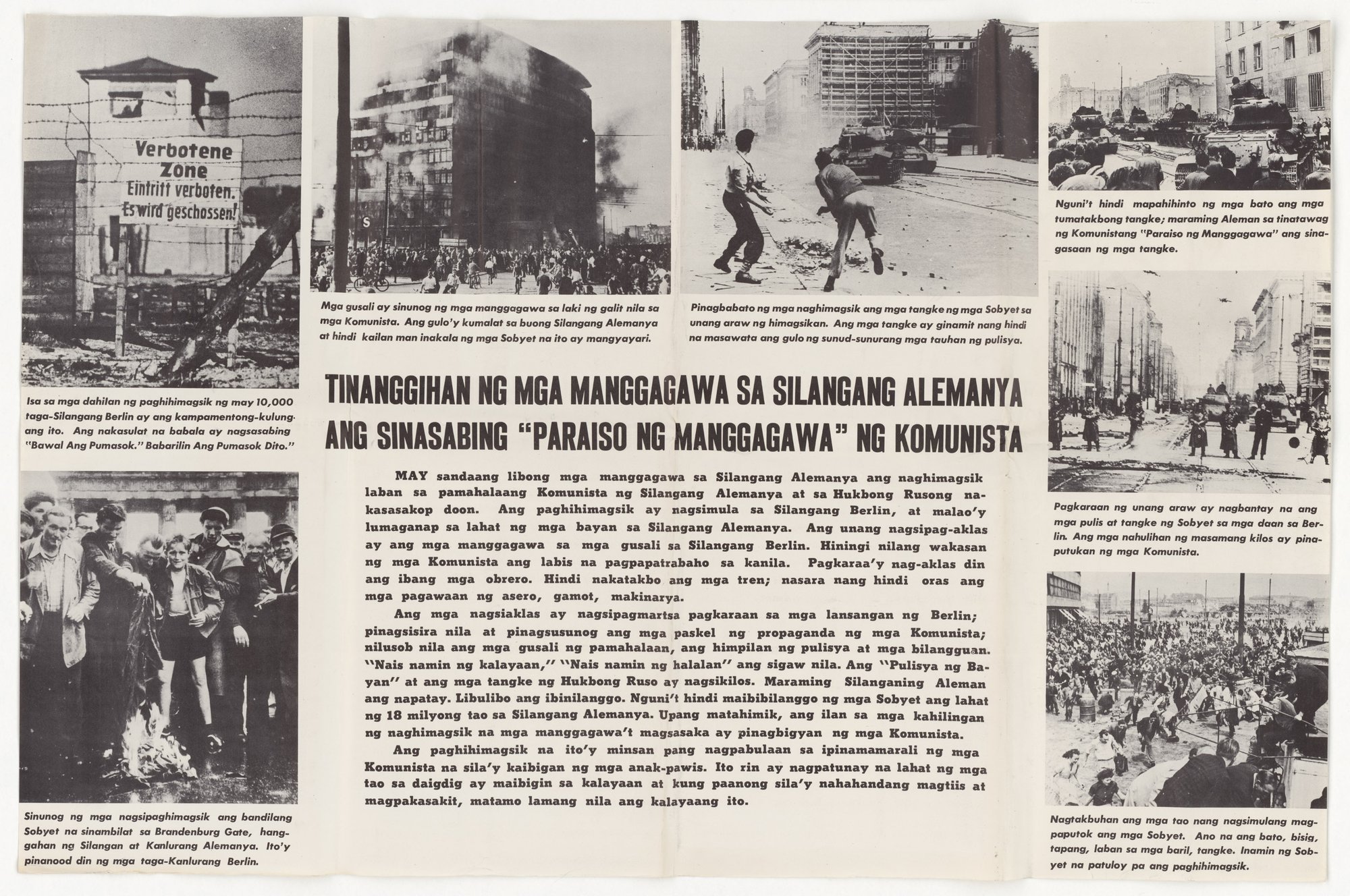
Tinanggihan ng mga Manggagawa ang "Paraiso ng Manggagawa" (East German Workers Reject the 'Workers' Paradise') (Tagalog poster, Philippines)
"Paraiso ng Manggagawa": the East German uprising for Tagalog readers
A 1953 Tagalog photo poster on the East German workers' uprising, quoting the Communist phrase "Workers' Paradise" in its headline. NARA RG 306, NAID
Techniques named on the archive record
Card stackingName-calling
Date
July 30, 1953
Made by
U.S. Information Agency (predecessor: State Department International Information and Educational Exchange Program), Propaganda Posters Distributed in Asia series
U.S. National Archives (NARA), Record Group 306, Propaganda Posters Distributed in Asia , retrieved October 3, 2026
Source
Public domain (U.S. government work; NARA RG 306) U.S. Information Agency / Department of State, July 30, 1953. National Archives, Record Group 306 (NAID 5730164, 306-PPA-263).
Object, image, and catalog record from the FRAME archive. Text on this page is CC BY 4.0. Image rights are as the archive records.
A Tagalog photo sheet filed with U.S. Information Agency posters distributed in Asia, catalog date 30 July 1953. Captioned photographs and a block of text tell of East German workers rising against their Communist government and Soviet tanks, under a headline that quotes the phrase "Workers' Paradise" (NAID 5730164).
What the sheet shows
The archive lists the pictures: a barbed-wire sign reading "Verbotene Zone", a burning building, young men throwing stones at a Soviet tank, tanks in Berlin streets, a Soviet flag being burned, and a crowd running from gunfire. A long text block follows the headline.
TINANGGIHAN NG MGA MANGGAGAWA SA SILANGANG ALEMANYA ANG SINASABING "PARAISO NG MANGGAGAWA" NG KOMUNISTA
[...] "Nais namin ang kalayaan," "Nais namin ang halalan" ang sigaw nila. [...]
[Archive's English translation:] EAST GERMAN WORKERS REJECT THE COMMUNISTS' SO-CALLED 'WORKERS' PARADISE' [...] 'We want freedom,' 'We want elections' were their cries. The 'People's Police' and the Russian Army's tanks moved. Many East Germans were killed. Thousands were jailed. [...]
In the Asia poster file
The National Archives keeps the sheet in Record Group 306, among the U.S. Information Agency's propaganda posters distributed in Asia. The maker line names the agency and its State Department predecessor, the International Information and Educational Exchange Program. Nothing in the transcription names an American office, and FRAME classes the source as blurred. The record gives no print run.
"We want freedom," without a sender
FRAME tags the sheet card stacking and name-calling, and files its purpose as "demonize." The card stacking is plain: as the archive puts it, only photographs of the protesters and the tanks are used. The headline puts the Communists' own slogan in quotation marks and lets the pictures answer it.
Two numbers on the sheet do not match, and the reader is not told why. One caption speaks of an uprising of some 10,000 East Berliners. The main text says a hundred thousand workers in East Germany rebelled. Neither figure has a source.
The core of the story is still worth telling. As the sheet reports it, workers struck against a government that claimed to rule in their name, and what they shouted for was freedom and elections. A state that answers that demand with police and tanks has shown what it is. The poster's flaw is its silence about its sender. A reader in the Philippines was not told that a foreign government had chosen these pictures. Compare the program's earlier Kremlin's Words and Deeds, which argued by table, and The World's Largest Prison. The program is described on the USIA posters abroad hub.
Sources
FRAME object record, Tinanggihan ng mga Manggagawa ang "Paraiso ng Manggagawa" (East German Workers Reject the 'Workers' Paradise') (Tagalog poster, Philippines). Catalog date July 30, 1953.
U.S. National Archives, Record Group 306, Propaganda Posters Distributed in Asia, item NAID 5730164, 306-PPA-263, catalog.archives.gov, retrieved by the archive October 3, 2026. Rights as recorded: public domain (U.S. government work).