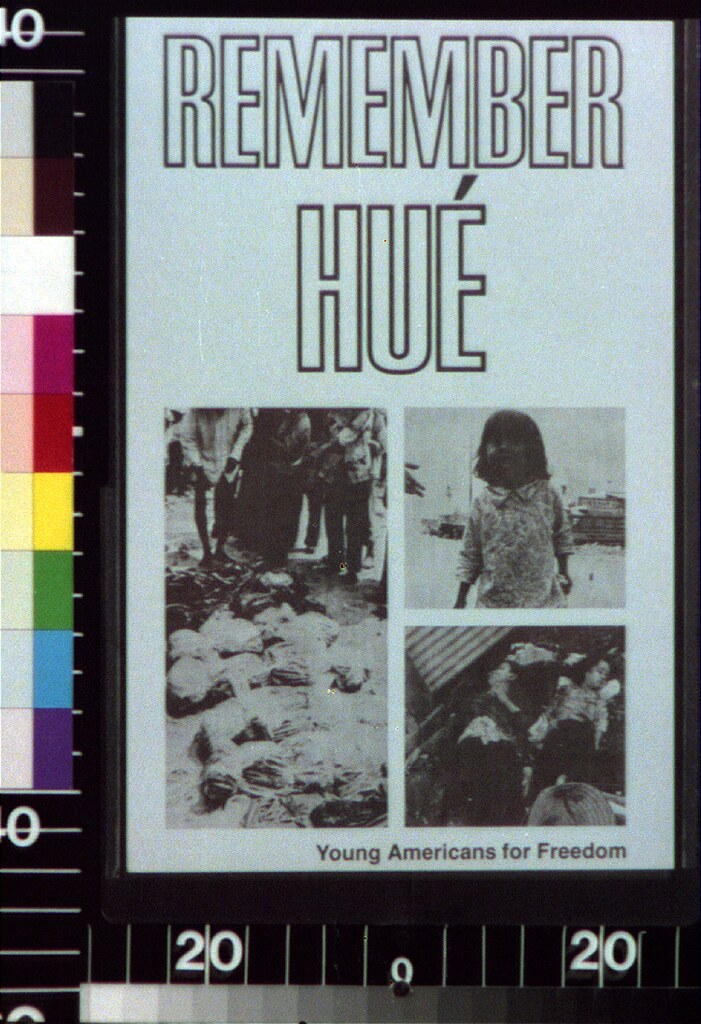
Remember Hue is a 1968 poster by Young Americans for Freedom of Washington, D.C. Under the two-word heading, three uncaptioned photographs show rows of covered bodies, a child in a street and a group of people crouched together. The archive reads it as an argument against the antiwar position that gives no numbers, dates or sources.
What is on it
Content note: the photographs show rows of covered bodies and grieving people after the 1968 fighting at Hue, as published.
The poster is pale blue. Its heading is two words, and the only other text is the name of the group that published it.
REMEMBER HUÉ
Young Americans for Freedom
Below the heading are three black-and-white photographs, none of them captioned. The archive describes them as rows of covered bodies lying on the ground, a child standing in a street, and a group of people crouched together.
Who made it
Young Americans for Freedom, of Washington, D.C., is the only name on the sheet. FRAME codes the issuer type as "Movement," the audience as the domestic public, and the source category as "Identified": the speaker is who it says it is. The Library of Congress holds the print. Its rights line reads "U.S. publication without copyright notice," with no known restrictions on publication, and the archive retrieved it on 2 October 2026.
How it argues
FRAME tags fear appeal and card stacking. The archive's reading is that the title and photographs present the deaths at Hue as the reason to oppose the antiwar position, and that the poster gives no numbers, no dates, no sources and no cause of death. The viewer is asked to supply all of that from what he already believes.
That is the weakness of the form. A photograph of the dead with no caption cannot be checked, and it can be claimed by whoever prints it. The Liberated by the Viet Cong poster of the same year at least captioned each of its nine photographs and called them a sample; this one asks for trust with two words.
It was also entirely legitimate speech. A group of private citizens printed its view of the war under its own name, licensed by no one. The same group's Tell It to Hanoi took the antiwar movement's own peace symbol and turned it around the next year, and the How many more must die? poster of 1969 asked about the dead from the other side of the argument. The Vietnam War messaging hub judges both sides by one standard, and its gallery holds the rest.
Sources
- FRAME object record, Remember Hue, 1968. Young Americans for Freedom (Washington, D.C.). Rights as recorded: U.S. publication without copyright notice; LoC: no known restrictions on publication.
- Library of Congress Prints and Photographs Division, item 2016648480, retrieved by the archive 2 October 2026.