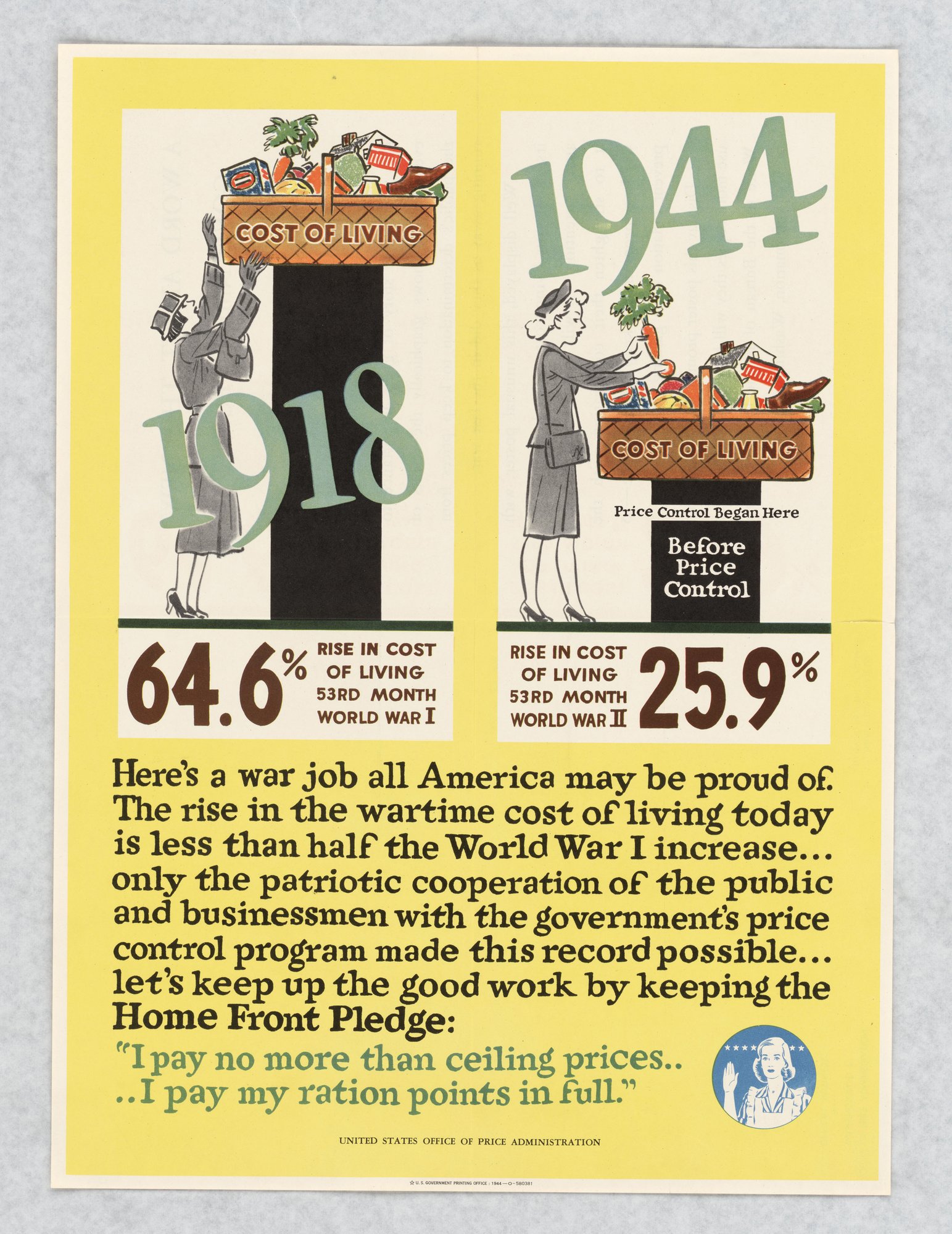
A 1944 Office of Price Administration poster sets two shopping baskets on columns of different heights: a 64.6 percent rise in the cost of living by the 53rd month of World War I, and 25.9 percent by the 53rd month of World War II. It credits price control and closes on the Home Front Pledge (NAID 514088).
Two baskets
On the left a woman stretches up toward a basket set on a tall black column, marked 1918. On the right a woman takes from a basket on a short column, marked 1944. The figures are printed beside each, and the text below says who should get the credit.
1918
64.6% RISE IN COST OF LIVING 53RD MONTH WORLD WAR I
1944
Price Control Began Here
Before Price Control
RISE IN COST OF LIVING 53RD MONTH WORLD WAR II 25.9%
COST OF LIVING
Here's a war job all America may be proud of.
The rise in the wartime cost of living today is less than half the World War I increase... only the patriotic cooperation of the public and businessmen with the government's price control program made this record possible... let's keep up the good work by keeping the Home Front Pledge:
"I pay no more than ceiling prices.. ..I pay my ration points in full."
UNITED STATES OFFICE OF PRICE ADMINISTRATION
Source of the sheet
The Office of Price Administration signs it in full, and a Government Printing Office imprint dates the printing to 1944. The sheet survives at the National Archives in Record Group 44, World War II Posters, 44-PA-610 (NAID 514088). FRAME tags card stacking and transfer.
What the numbers carry
The comparison is a fair kind of argument. It picks the same point in each war, the 53rd month, and gives a figure for each. That is more than many posters gave. A reader could hold the agency to its numbers.
The card stacking is in what surrounds them. The sheet names no source for either percentage. Its labels mark the point where "Price Control Began," and then the text assigns the whole difference to "the patriotic cooperation of the public and businessmen" with the program. Other causes, if there were any, are not considered. A companion OPA sheet, Cost of Living in Two Wars, makes the same case with a line chart that, in the archive's words, gives no scale or dates.
A second limit is one the agency's own posters admit. In 1944 the OPA was printing counter cards asking customers to help "smash the black market," and in 1946 it was calling buyers who paid over the ceiling "Sucker!" Some trade happened above the posted prices. This poster does not say whether its index caught it.
The earlier war is on this site too. The World War I Food Administration asked households for a "voluntary ration" of sugar, as the store card Your Sugar Ration Is 2 lbs. per Month shows, and the World War I home-front hub gathers its posters. The 1944 sheet measures itself against that record without describing it. The other price sheets are on the rationing and price control hub.
Sources
- FRAME object record, Cost of living 1918, 1944: Home Front Pledge, 1944. United States Office of Price Administration. Rights as recorded: public domain (U.S. government work).
- U.S. National Archives and Records Administration, Record Group 44, World War II Posters, 44-PA-610, NAID 514088, retrieved by the archive 4 October 2026.