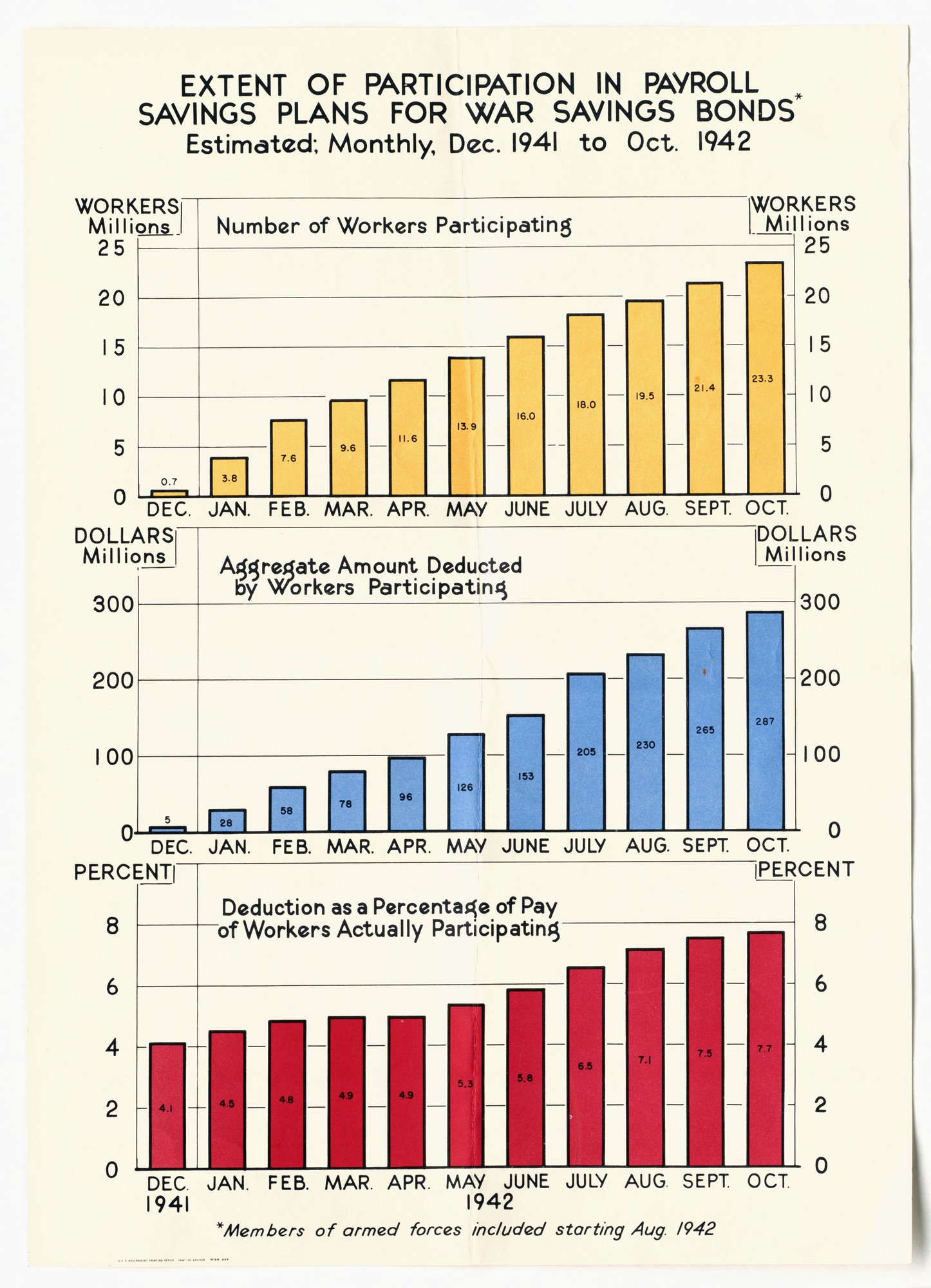
This 1942 sheet is a government bar chart with no picture on it. It estimates how many workers had War Savings Bond deductions taken from their pay between December 1941 and October 1942 (0.7 million at the start, 23.3 million at the end), how many dollars were deducted, and what share of pay the participants set aside (NAID 514232).
The numbers on the sheet
Most bond posters ask. This one reports. It is three bar charts stacked on one sheet, each running month by month from December 1941 to October 1942, and the only picture is the bars themselves. The sheet labels its figures as estimates.
EXTENT OF PARTICIPATION IN PAYROLL SAVINGS PLANS FOR WAR SAVINGS BONDS*
Estimated: Monthly, Dec. 1941 to Oct. 1942
Number of Workers Participating
DEC. 0.7; JAN. 3.8; FEB. 7.6; MAR. 9.6; APR. 11.6; MAY 13.9; JUNE 16.0; JULY 18.0; AUG. 19.5; SEPT. 21.4; OCT. 23.3
Aggregate Amount Deducted by Workers Participating
DEC. 5; JAN. 28; FEB. 58; MAR. 78; APR. 96; MAY 126; JUNE 153; JULY 205; AUG. 230; SEPT. 265; OCT. 287
Deduction as a Percentage of Pay of Workers Actually Participating
DEC. 4.1; JAN. 4.5; FEB. 4.8; MAR. 4.9; APR. 4.9; MAY 5.3; JUNE 5.8; JULY 6.5; AUG. 7.1; SEPT. 7.5; OCT. 7.7
*Members of armed forces included starting Aug. 1942
Read plainly, the worker count rose more than thirtyfold between December and October, and the share of pay that participants put aside nearly doubled, from 4.1 to 7.7 percent. The dollar row is headed "aggregate amount deducted"; the sheet does not say in words whether each bar is that month's deductions or a running total, so this page does not choose.
Who printed it
No office is named. The foot of the sheet carries a Government Printing Office job number for 1942, and the rest of the imprint is illegible. The National Archives holds it with the World War II posters in Record Group 44, and FRAME credits it to the U.S. government without naming a department.
How to read it
A chart like this is the instrument behind the posters. The Treasury's 1942 score chart gave each firm blank rows for the "% of employees enrolled," and the Aim to Win sheet set ten percent of every paycheck as the target. This sheet is the national version of the same tally. By October 1942, on its own numbers, the average participant was still under that ten percent mark.
Two cautions belong with the figures. They are the government's estimates of its own program, printed without a method. And the footnote changes who is counted halfway through: from August 1942 the bars include members of the armed forces, so the climb after July is not a like-for-like comparison with the months before it.
The open question is what "participation" meant to the person being counted. The 1943 government sheets quoting Admiral King and General Marshall both print the word "VOLUNTARY" in the plan's name, and nothing in the archive's records shows a penalty for staying out. What the records do show is that each worker's choice was being added up, by firm and by nation. This site's reading is that a choice can be voluntary in law and still made under a public count, and that the count is the part worth noticing. The rest of the payroll sheets are gathered on World War II war bonds and war stamps, 1941–1946.
Sources
FRAME object record, Extent of participation in payroll savings plans for War Savings Bonds, 1942. U.S. government (issuer not printed; Government Printing Office 1942 imprint). Rights as recorded: public domain (U.S. government work).
U.S. National Archives and Records Administration, Record Group 44, World War II Posters, 44-PA-745, NAID 514232, retrieved by the archive 4 October 2026.