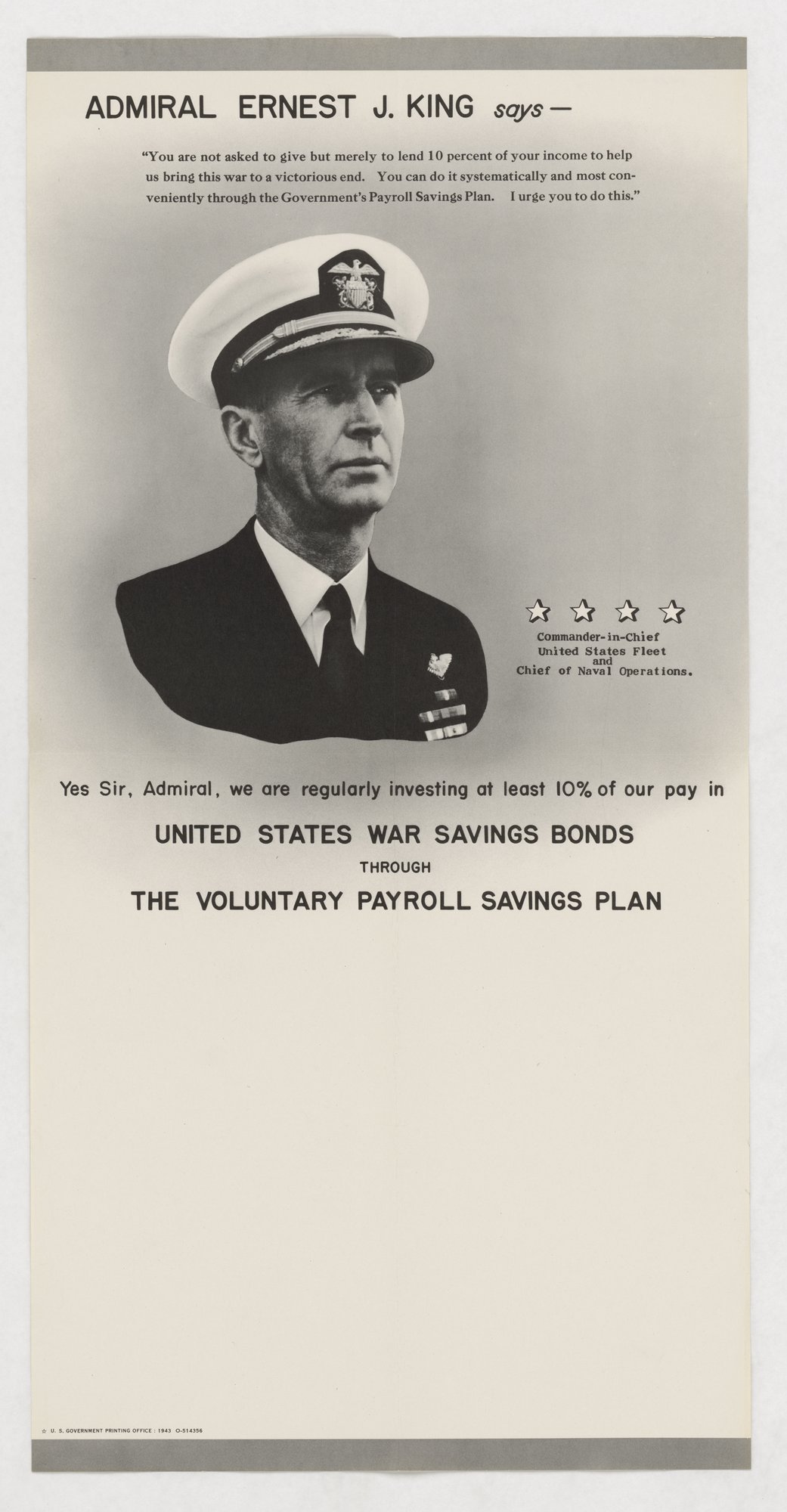
A 1943 Government Printing Office poster pairs a portrait of Admiral Ernest J. King with his request that Americans lend 10 percent of their income through the Payroll Savings Plan, then prints the workers' answer for them: "Yes Sir, Admiral." The plan is named on the sheet as voluntary (NAID 513753).
The words
The picture is a portrait of the admiral in a white cap. The text does the rest, in two voices: first the commander, then a reply written in the first person plural for the people reading it.
ADMIRAL ERNEST J. KING says—
"You are not asked to give but merely to lend 10 percent of your income to help us bring this war to a victorious end. You can do it systematically and most conveniently through the Government's Payroll Savings Plan. I urge you to do this."
Commander-in-Chief United States Fleet and Chief of Naval Operations.
Yes Sir, Admiral, we are regularly investing at least 10% of our pay in UNITED STATES WAR SAVINGS BONDS THROUGH THE VOLUNTARY PAYROLL SAVINGS PLAN
Who issued it
The sheet names no department. Its foot carries a Government Printing Office imprint for 1943, and FRAME credits it to the U.S. government, with King as the person quoted. A companion sheet in the same format, General George C. Marshall says, is credited to the Treasury's War Finance Division and ends with the same reply, "Yes sir, General."
How to read it
King's sentence is accurate about the transaction. A war bond was a loan, and the Treasury's own My Promise to You sheet lists the terms: redeemable after 60 days, $4 back for each $3 held ten years. Calling it lending rather than giving is the honest description, and the poster deserves credit for using it.
The pressure is in how the request is delivered. The request carries the titles printed under King's name, Commander-in-Chief of the United States Fleet and Chief of Naval Operations, and the poster then writes the reader's consent before the reader has given it. "Yes Sir, Admiral" is the answer a sailor gives an order. Printed over the word "voluntary," it makes a point the sheet probably did not intend: the plan was a free choice, and it was presented in the grammar of command.
The ten percent figure is the same norm set by Aim to Win and counted on the 1942 participation chart. The Roosevelt administration essay places the Treasury's bond drives beside the Office of War Information; World War II war bonds and war stamps, 1941–1946 sets this sheet among the other drives.
Sources
- FRAME object record, Admiral Ernest J. King says, 1943. U.S. Government (Government Printing Office imprint); Admiral Ernest J. King quoted. Rights as recorded: public domain (U.S. government work).
- U.S. National Archives and Records Administration, Record Group 44, World War II Posters, 44-PA-306, NAID 513753, retrieved by the archive 4 October 2026.