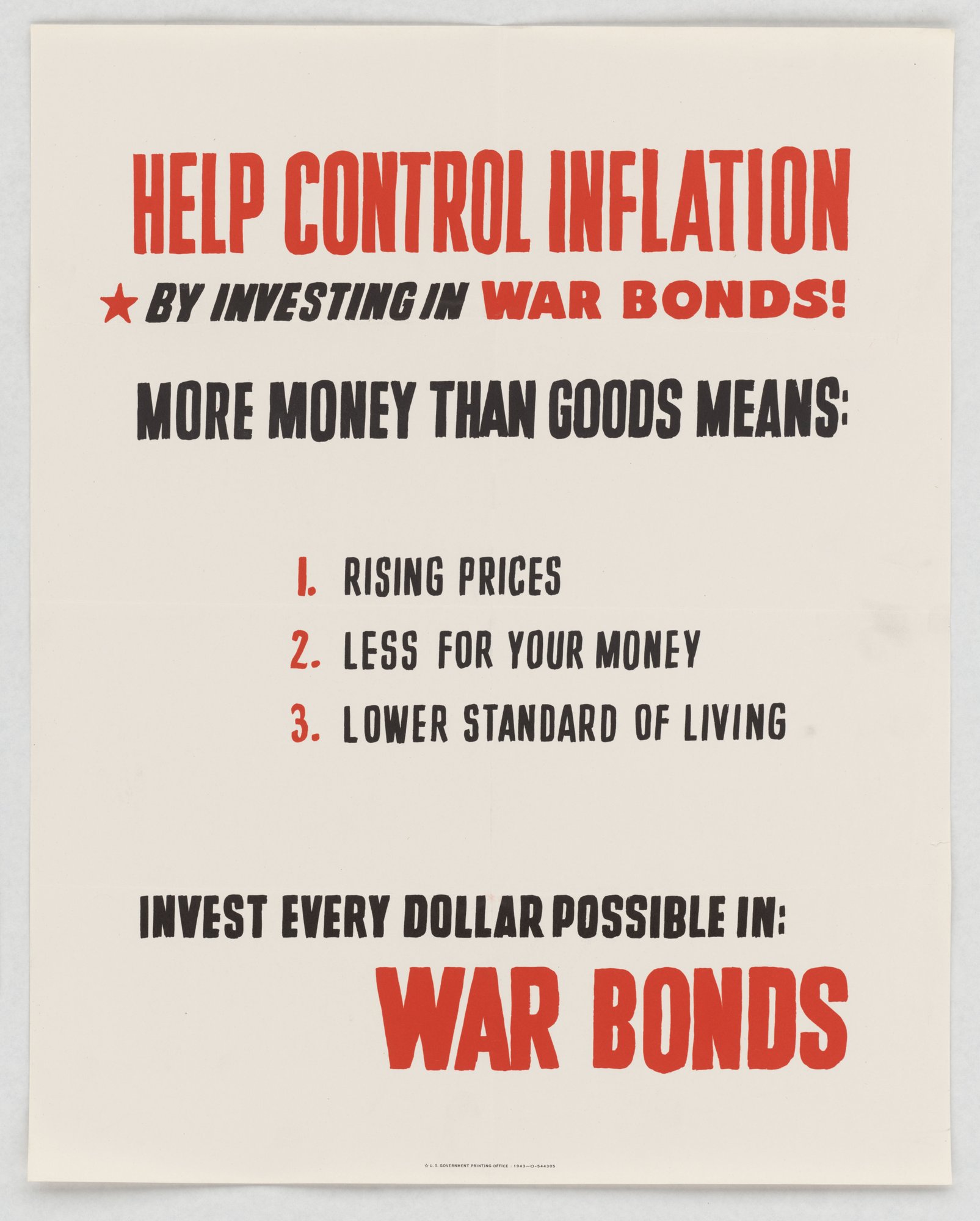
A 1943 Government Printing Office sheet in red and black type gives an economic reason to buy war bonds rather than a patriotic one. "More money than goods," it says, means rising prices, less for your money, and a lower standard of living, so readers should invest "every dollar possible" in war bonds (NAID 514459).
The argument
There is no image. The sheet is a short syllogism set in type: a cause, three effects, and one remedy.
HELP CONTROL INFLATION ★ BY INVESTING IN WAR BONDS!
MORE MONEY THAN GOODS MEANS:
1. RISING PRICES
2. LESS FOR YOUR MONEY
3. LOWER STANDARD OF LIVING
INVEST EVERY DOLLAR POSSIBLE IN: WAR BONDS
Who printed it
No office is named; FRAME credits the U.S. government on the strength of the printing-office imprint. That imprint, 1943-O-544305, is the same job number as My Promise to You, the sheet that lists a bond's terms, and Dollars in war bonds are double-duty dollars, which pairs bombers and jeeps "today" with homes and refrigerators "tomorrow." The National Archives holds all three in Record Group 44.
How to read it
The sheet does not ask anyone to avenge a soldier or picture an enemy. Its claim is that more money than goods pushes prices up, and the remedy it implies is that money lent to the Treasury is money not bidding up those prices. A reader can agree or disagree, but he is being given a reason.
What it leaves out is the rest of the policy. The Office of Economic Stabilization's sheets in the archive, distributed by the Office of War Information, list "buy and hold War Bonds" as the first of seven steps, followed by paying "our share of taxes," following "ration rules and price ceilings," and cooperating with the "wage stabilization program" (We'll take care of the Rising Sun, 1944). Some of those steps name rules, ration rules and price ceilings among them, rather than offers. Read beside them, the bond was a loan the citizen could decline, and that is a reason to respect this sheet's choice to argue rather than command.
"Every dollar possible" has no ceiling, and the sheet does not say what happens to the saver if prices rise anyway. Its logic concerns the economy. The buyer's return is on the companion sheet. For the reasons other sheets gave, see World War II war bonds and war stamps, 1941–1946.
Sources
- FRAME object record, Help control inflation by investing in War Bonds!, 1943. U.S. government (issuer not printed; U.S. Government Printing Office imprint). Rights as recorded: public domain (U.S. government work).
- U.S. National Archives and Records Administration, Record Group 44, World War II Posters, 44-PA-953, NAID 514459, retrieved by the archive 4 October 2026.