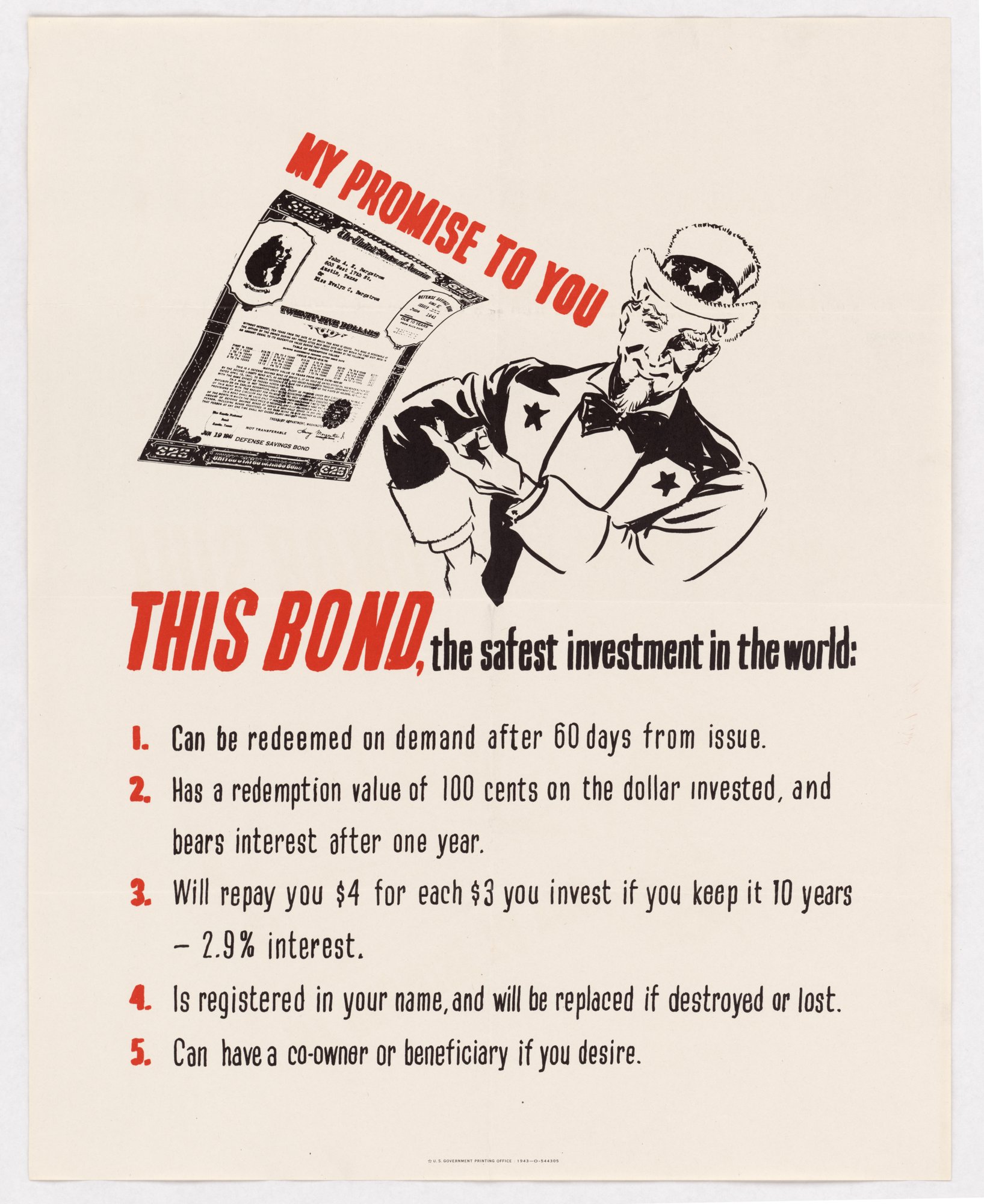
Printed in 1943 with no issuing office named, this poster shows Uncle Sam holding a $25 Defense Savings Bond issued in June 1941 and lists five terms: redemption on demand after 60 days, full return of principal, $4 for each $3 held ten years (2.9 percent), replacement if lost, and an optional co-owner (NAID 515040).
The terms, as printed
This bond poster reads more like a contract than an appeal. Uncle Sam holds up the certificate, and the numbered list beneath him tells the buyer what the government owes in return.
MY PROMISE TO YOU
THIS BOND, the safest investment in the world:
1. Can be redeemed on demand after 60 days from issue.
2. Has a redemption value of 100 cents on the dollar invested, and bears interest after one year.
3. Will repay you $4 for each $3 you invest if you keep it 10 years - 2.9% interest.
4. Is registered in your name, and will be replaced if destroyed or lost.
5. Can have a co-owner or beneficiary if you desire.
The bond in Uncle Sam's hand is a $25 Defense Savings Bond, "issued June 1941" and "due 10 years from issue date," made out to an owner in Austin, Texas, and stamped "not transferable." The poster itself carries a 1943 printing-office date. So a wartime sheet advertises the bond under its Defense name, a reminder that the Treasury was selling these bonds months before Pearl Harbor; the 1942 participation chart already calls them War Savings Bonds.
Who issued it
No department is printed. FRAME records the issuer as unnamed and notes the Government Printing Office imprint, 1943-O-544305. The archive records the same job number on several other sheets, most of them about bonds, among them Help control inflation by investing in War Bonds! and Dollars in war bonds are double-duty dollars.
How to read it
This is the request at its most respectful. It names the price, the term, the yield, and the exit, and it leaves the reader to decide. A citizen asked to lend money to his government is owed exactly this, and many bond posters gave him a soldier's face instead.
Two things on the sheet are less exact. "The safest investment in the world" is a slogan, and nothing on the poster supports it. And the promise is in dollars: the sheet says what the bond will repay, not what the repayment will buy. The 2.9 percent figure is what the poster prints for a bond held the full ten years. By term 2, a buyer who cashed in during the first year, as term 1 allowed after 60 days, got back only what he paid.
Term 1 matters for the campaign as a whole. A bond could be redeemed after 60 days, and later Treasury posters, such as Nest eggs won't hatch (1944) and the 1945 1946 Resolution, asked holders not to use that right. Asking was within the government's rights. So was the holder's decision to cash in. Other sheets that print terms or prices are listed on World War II war bonds and war stamps, 1941–1946.
Sources
- FRAME object record, My promise to you: this bond, the safest investment in the world, 1943. Unnamed issuer (no issuing body printed; U.S. Government Printing Office imprint). Rights as recorded: public domain (U.S. government work).
- U.S. National Archives and Records Administration, Record Group 44, World War II Posters, 44-PA-1381, NAID 515040, retrieved by the archive 4 October 2026.