Korea Exhibit poster No. 2b: soldier's testimony (Thai, distributed in Bangkok)
Buried alive for 52 hours: Korea Exhibit sheet 2b for Bangkok, 1954
Korea Exhibit No. 2b, a 1954 Thai sheet for Bangkok: a sergeant points to the pit where the caption says he lay buried alive 52 hours. USIA file, NAID
Techniques named on the archive record
TestimonialOutrage bait
Date
August 30, 1954
Made by
U.S. Information Agency (predecessor: State Department International Information and Educational Exchange Program), Propaganda Posters Distributed in Asia, Latin America and the Middle East series
U.S. National Archives (NARA), RG 306, Posters Distributed in Asia, Latin America, Middle East , retrieved October 4, 2026
Source
Public domain (U.S. government work; NARA RG 306) U.S. Information Agency / Department of State, 30 August 1954. National Archives, Record Group 306 (NAID 6949015, 306-PPB-142b).
Object, image, and catalog record from the FRAME archive. Text on this page is CC BY 4.0. Image rights are as the archive records.
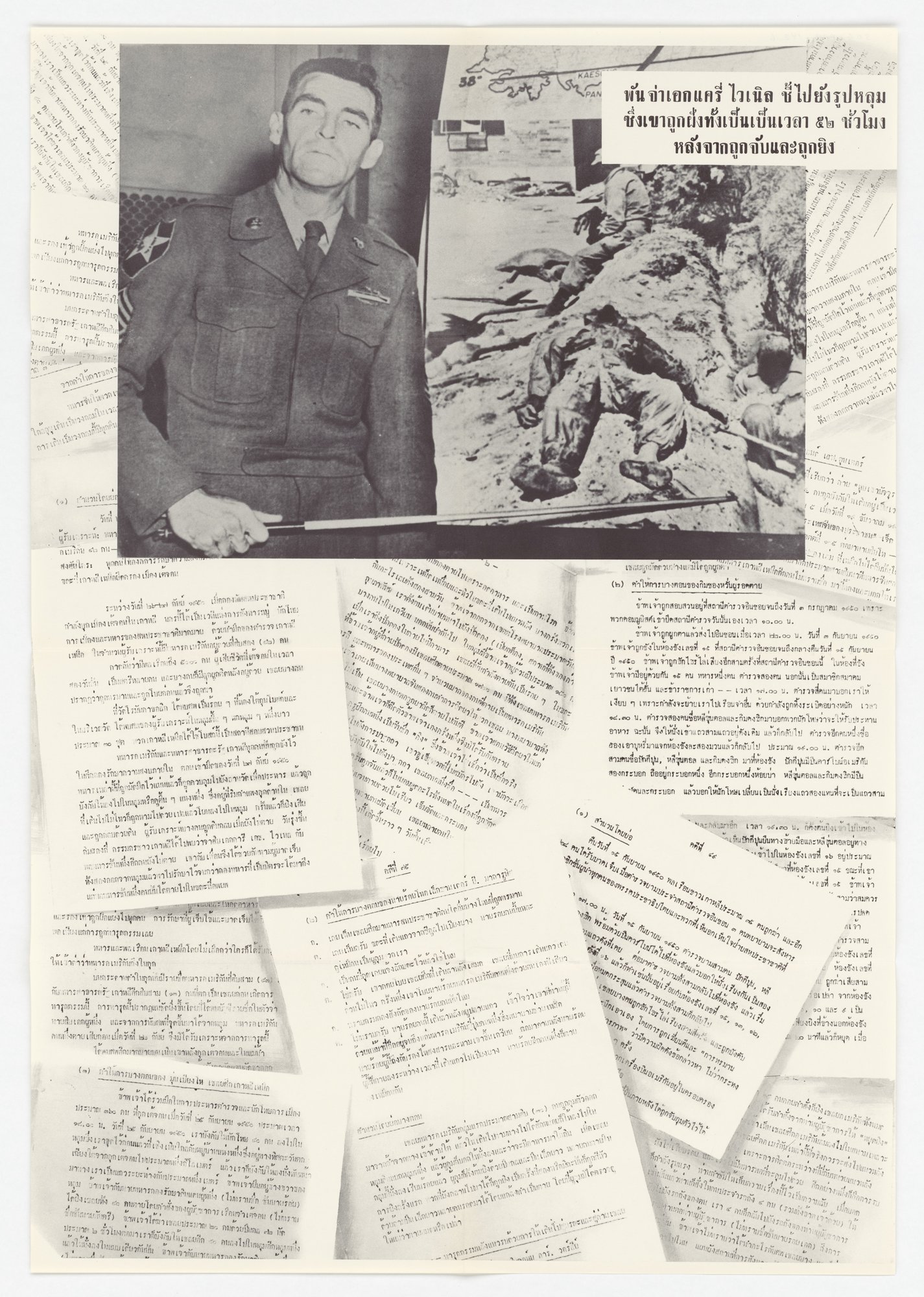
A Thai-language exhibit sheet, Korea Exhibit No. 2b, in the U.S. Information Agency file, catalog date 30 August 1954. A sergeant stands beside a photograph of bodies on a slope, and the caption says he is pointing to the pit where he was buried alive for 52 hours after being captured and shot (NAID 6949015).
What the sheet holds
The upper half is a scene: a uniformed sergeant beside a large photograph of bodies lying on a slope, and a map marked with the number 38 and the name Kaesong. One caption explains what he is pointing at. The lower half is a collage of typed Thai pages, each headed with a case number, laid over one another like a file of statements.
พันจ่าเอกแครี่ ไวเนิล ชี้ไปยังรูปหลุม
ซึ่งเขาถูกฝังทั้งเป็นเป็นเวลา ๕๒ ชั่วโมง
หลังจากถูกจับและถูกยิง
[English, as given by the archive:] Master Sergeant Carey Weinel [name as transliterated from the Thai] points to the picture of a pit in which he was buried alive for 52 hours after being captured and shot.
Part of an exhibit
The National Archives files this sheet in Record Group 306 with the U.S. Information Agency's posters for Asia, Latin America and the Middle East, catalog date 30 August 1954. The site's Korean War hub describes the whole Thai Korea Exhibit as post-armistice work that pairs the UN General Assembly's December 1953 resolution on atrocities against prisoners of war with survivors' testimony and photographs of the dead. Beside 2b in the archive sit sheet 2a, a UN resolution text, and sheet 2c, weapon and casualty photographs. No sender is printed on 2b as transcribed, and FRAME classes the source as blurred.
Testimony as proof
FRAME's tags are testimonial and outrage bait. The first describes the method: a named survivor and a stack of typed statements stand in for the evidence. The second describes the effect the photograph of bodies is built to have.
The charge is grave. If the caption is accurate, a prisoner was shot and left in a pit, and a government holding a survivor's account had good reason to make it public. Publishing it this way has a cost. A Thai visitor to the exhibit saw a caption, a rank and a name, and typed statements laid one over another, which the archive itself did not transcribe. The record does not show where the statements came from, who took them, or whether any were tested by anyone outside the governments at war. Testimony offered with its sources can be weighed. Testimony offered as a backdrop asks the viewer to feel first.
FRAME object record, Korea Exhibit poster No. 2b: soldier's testimony (Thai, distributed in Bangkok), catalog date 30 August 1954. U.S. Information Agency (predecessor: State Department International Information and Educational Exchange Program), Propaganda Posters Distributed in Asia, Latin America and the Middle East series.
U.S. National Archives and Records Administration, Record Group 306, NAID 6949015 (306-PPB-142b), retrieved by the archive 4 October 2026. Rights as recorded: public domain (U.S. government work).