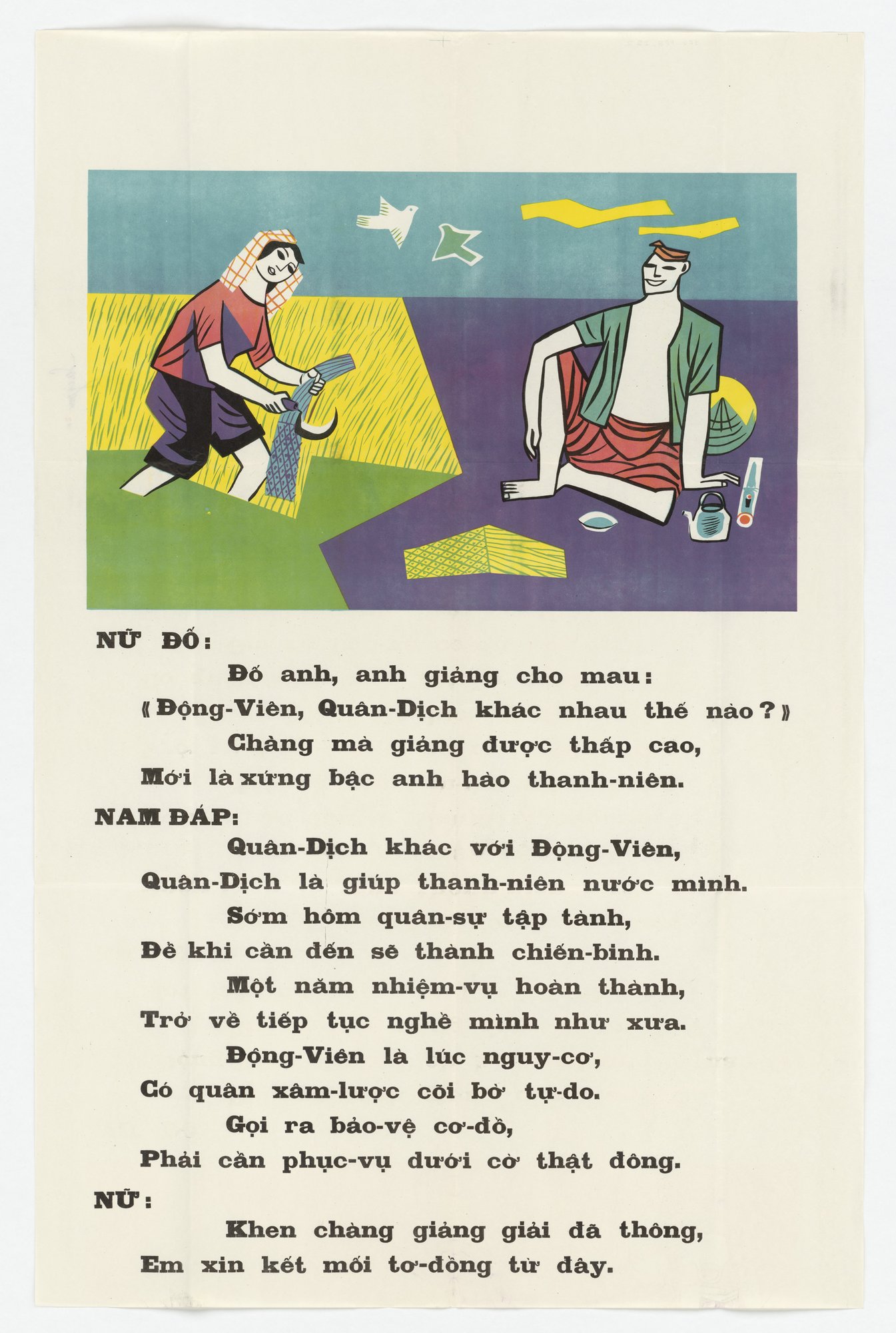
Meaning of Compulsory Service poster 222 (Vietnamese poster distributed in Saigon)
Conscription explained as a courtship riddle on a 1957 Saigon poster
A May 1957 USIA poster for Saigon explains South Vietnam's one-year compulsory service in a rhymed courtship riddle. No imprint. NARA RG 306, NAID 6949134.
Techniques named on the archive record
Plain folksGlittering generalities
Date
May 24, 1957
Made by
U.S. Information Agency (predecessor: State Department International Information and Educational Exchange Program), Propaganda Posters Distributed in Asia, Latin America and the Middle East series
U.S. National Archives (NARA), Record Group 306, Posters in Asia, Latin America, Middle East , retrieved October 4, 2026
Source
Public domain (U.S. government work; NARA RG 306) U.S. Information Agency / Department of State, May 24, 1957. National Archives, Record Group 306 (NAID 6949134, 306-PPB-222).
Object, image, and catalog record from the FRAME archive. Text on this page is CC BY 4.0. Image rights are as the archive records.
A Vietnamese-language poster in the U.S. Information Agency series for Asia, catalog date 24 May 1957 (NAID 6949134), sets a rhymed exchange between a young woman and a young man: she asks how conscription differs from mobilization, he explains, and she agrees to marry him.
The picture and the verse
A colored print in a woodcut manner shows a woman cutting rice and a young man sitting at ease beside his conical hat and a teapot, smiling. Below them runs a dialogue in rhymed couplets, set out like a folk riddle. She poses the question; he answers it; she gives her verdict.
« Động-Viên, Quân-Dịch khác nhau thế nào ? »
[...]
Một năm nhiệm-vụ hoàn thành,
Trở về tiếp tục nghề mình như xưa.
[...]
Khen chàng giảng giải đã thông,
Em xin kết mối tơ-đồng từ đây.
In the man's answer, compulsory service "is to help the youth of our country": a year of drill, after which a man goes back to his work. Mobilization is different: it comes when an invader threatens the border, and then many must serve under the flag.
Where it comes from
No imprint or credit is printed. The National Archives holds the sheet in Record Group 306 among the U.S. Information Agency's posters for Asia, Latin America and the Middle East (item NAID 6949134, 306-PPB-222), with a catalog date of 24 May 1957 and Saigon as the place of distribution. FRAME classes the source as blurred. Nothing on the sheet told a reader in 1957 who made it; the file says an American agency's poster series carried it.
How to read it
FRAME tags it plain folks and glittering generalities. The plain folks device is the whole setting: a farm couple, a teapot, a joke, a proposal of marriage. A state requirement is made to look like village common sense, and the young man who understands it wins the girl. The generality is "helping the youth": service is described as something done for the conscript, not something required of him.
The poster tells the truth about one distinction it draws. A year of peacetime training and a wartime call-up are different things, and explaining the difference is a fair use of a public notice. What it leaves out is the part that matters most to the man being drafted: the year is not optional, and the line between "a year and home again" and "mobilization" is drawn by the government, not by him.
That is a question Americans would argue about at home a decade later. The site reads conscription as coercion, which is a judgment about liberty rather than a fact on this sheet: a free country can ask for soldiers, and a draft takes them. Compare the 1968 U.S. Army poster "Your future, your decision", printed while the American draft was in force. The full period, 1954 to 1975, is covered in US Vietnam War messaging.
Sources
FRAME object record, Meaning of Compulsory Service poster 222 (Vietnamese poster distributed in Saigon). U.S. Information Agency series. Catalog date 24 May 1957.
U.S. National Archives, Record Group 306, Posters in Asia, Latin America, Middle East, item NAID 6949134 (306-PPB-222), retrieved by the archive 4 October 2026. Rights as recorded: public domain (U.S. government work).