Library of Congress , retrieved September 29, 2026
Source
U.S. publication without copyright notice; LoC: no known restrictions on publication Library of Congress Prints and Photographs Division Washington, D.C. 20540 USA http://hdl.loc.gov/loc.pnp/pp.print
Object, image, and catalog record from the FRAME archive. Text on this page is CC BY 4.0. Image rights are as the archive records.
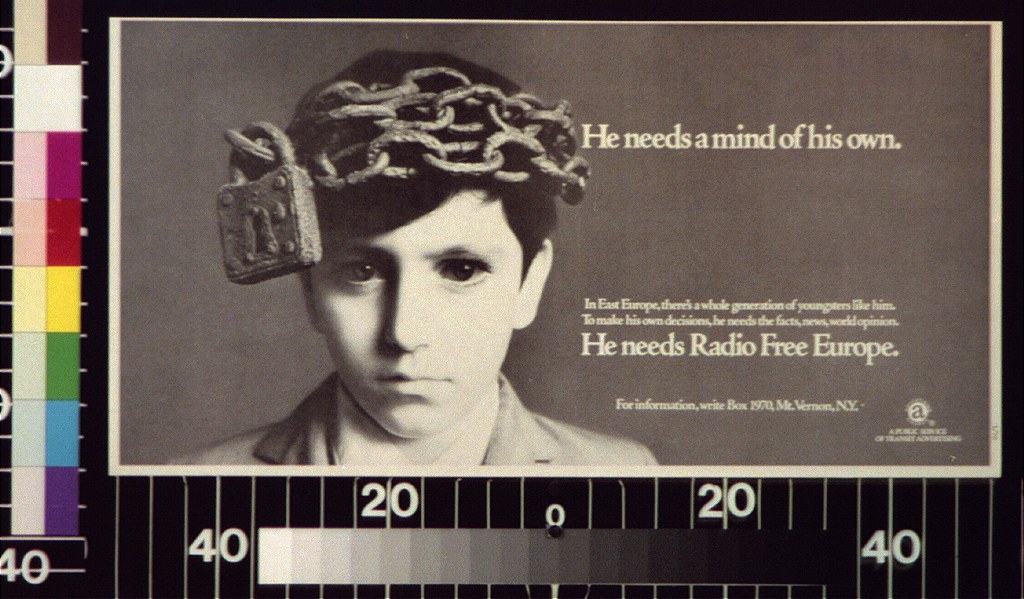
A 1970 transit advertisement for Radio Free Europe, carrying the Advertising Council mark and the line "A public service of Transit Advertising," shows a solemn child with a chain and padlock round his head and the words "He needs a mind of his own" and "He needs Radio Free Europe." It does not say who paid for the station.
The card
This is a transit card. A child's face fills the picture, solemn, with a chain wrapped round his head and closed with a padlock. The copy is short, and it ends with a box number in Mount Vernon, New York, for readers who want more information.
He needs a mind of his own.
In East Europe, there's a whole generation of youngsters like him.
To make his own decisions, he needs the facts, news, world opinion.
He needs Radio Free Europe.
For information, write Box 1970, Mt. Vernon, N.Y.
[Advertising Council logo] A PUBLIC SERVICE OF TRANSIT ADVERTISING
What it says, and what it leaves out
The message itself is one a free country can stand behind. A young person "needs the facts, news, world opinion" to make his own decisions. That is the case for open information.
The archive tags the ad for transfer and for narrative laundering. The transfer is the chain and padlock, the picture of captivity put on a child's head so that the station reads as the key. The laundering is in the frame around it. The Advertising Council mark and the public-service line present Radio Free Europe as a civic cause the reader might help, and the ad never says where the station's money came from. The archive files the source as unidentified, its category for sponsorship that is blurred or buried, and the issuer as mixed.
A citizen reading this card in 1970 could not learn from it that his own government had a hand in the station. The ad asks him to support freedom of information while withholding a fact about itself. The 1954 Truth Dollar appeal cites the archive's statement that until 1971 Radio Free Europe was funded mainly by the U.S. government through the CIA.
Related on this site
The Crusade for Freedom case study sets out how Americans were asked to give to a radio service their government was already paying for. The 1951 donor stamp is an earlier piece of the same fund-raising. The USIA posters hub covers government posters printed for audiences abroad and treats the CIA-funded Crusade for Freedom as the covert contrast.
Sources
FRAME object record, He needs a mind of his own ... he needs Radio Free Europe, 1970. Radio Free Europe (with the Advertising Council; placed as a public service by Transit Advertising).
Library of Congress, Prints and Photographs Division, catalog record, retrieved by the archive 29 September 2026. Rights as recorded: U.S. publication without copyright notice; LoC: no known restrictions on publication.