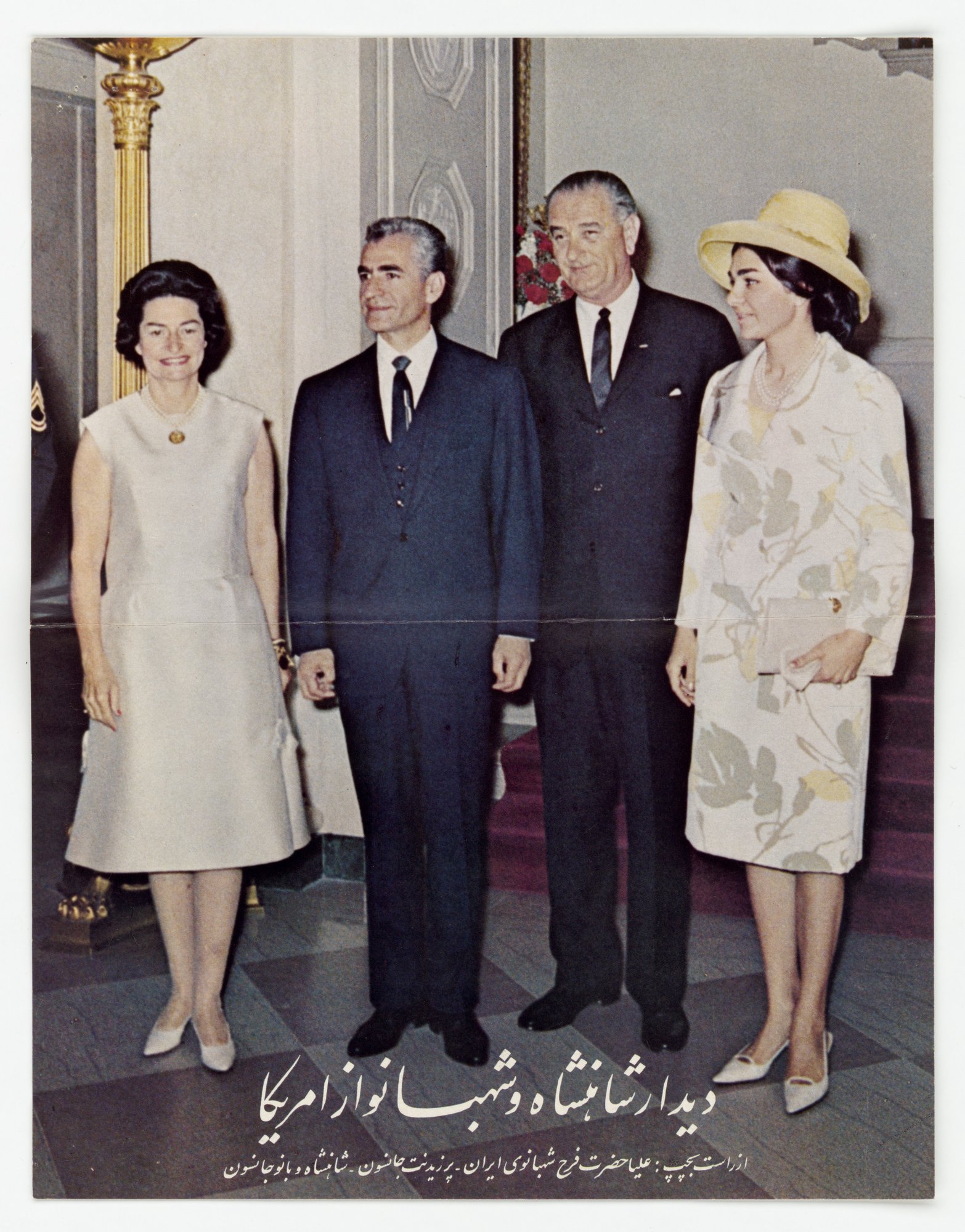
A Persian-language U.S. Information Agency poster distributed in Tehran, catalog date 1 January 1964, prints a color photograph of four people in a formal room. Its caption names them, right to left, as Empress Farah, President Johnson, the Shahanshah and Mrs. Johnson, and calls the occasion the royal couple's visit to America (NAID 6949226).
The photograph and its caption
The sheet is a single color photograph. Four people stand together in a formal interior. The caption is two lines of Persian, and those two lines are all the text the archive records.
دیدار شاهنشاه و شهبانو از امریکا
از راست بچپ: علیاحضرت فرح شهبانوی ایران - پرزیدنت جانسون - شاهنشاه و بانو جانسون
The archive gives the sense in English in a machine translation it labels as not verified by a fluent reader: the first line names the visit of the Shahanshah and the Empress to America, and the second identifies the four from right to left as Empress Farah of Iran, President Johnson, the Shahanshah and Mrs. Johnson.
Who sent it
The poster is in the National Archives series of propaganda posters the U.S. Information Agency and its State Department predecessors distributed in Asia, Latin America and the Middle East. The archive's catalog date is 1 January 1964. FRAME codes the audience as a foreign public, the purpose as "Commemorate," and the theme as media and information.
Its source category is "Source blurred: contractors, cutouts, buried disclosure." On the evidence of the transcription, the sheet credits no American office. A viewer in Tehran saw a royal souvenir and had nothing on its face to tell him which government had printed it.
What it does
FRAME tags one technique, transfer. Two heads of state and their wives stand side by side, and the standing of each lends something to the other. The caption is a list of names. There is no slogan, no policy and no claim a reader could dispute.
That restraint is the sheet's strength as a souvenir and the source of the one fair objection to it. A friendly photograph is ordinary diplomacy. A friendly photograph printed for the host country's public by a foreign information agency, with the agency's name left off, is persuasion that hides its sender. The USIA hub applies the same test to the whole program: does the reader know who is talking? On the transcription the archive gives, the answer is no.
The same year, the agency billed a Kennedy memorial film for audiences in Beirut. More sheets are in the USIA poster gallery.
Sources
- FRAME object record, Shah-Johnson Souvenir poster (Persian, distributed in Tehran), 1 January 1964. U.S. Information Agency (predecessor: State Department International Information and Educational Exchange Program), Propaganda Posters Distributed in Asia, Latin America and the Middle East series.
- U.S. National Archives, Record Group 306, NAID 6949226 (306-PPB-302), retrieved by the archive 4 October 2026. Rights as recorded: public domain (U.S. government work).