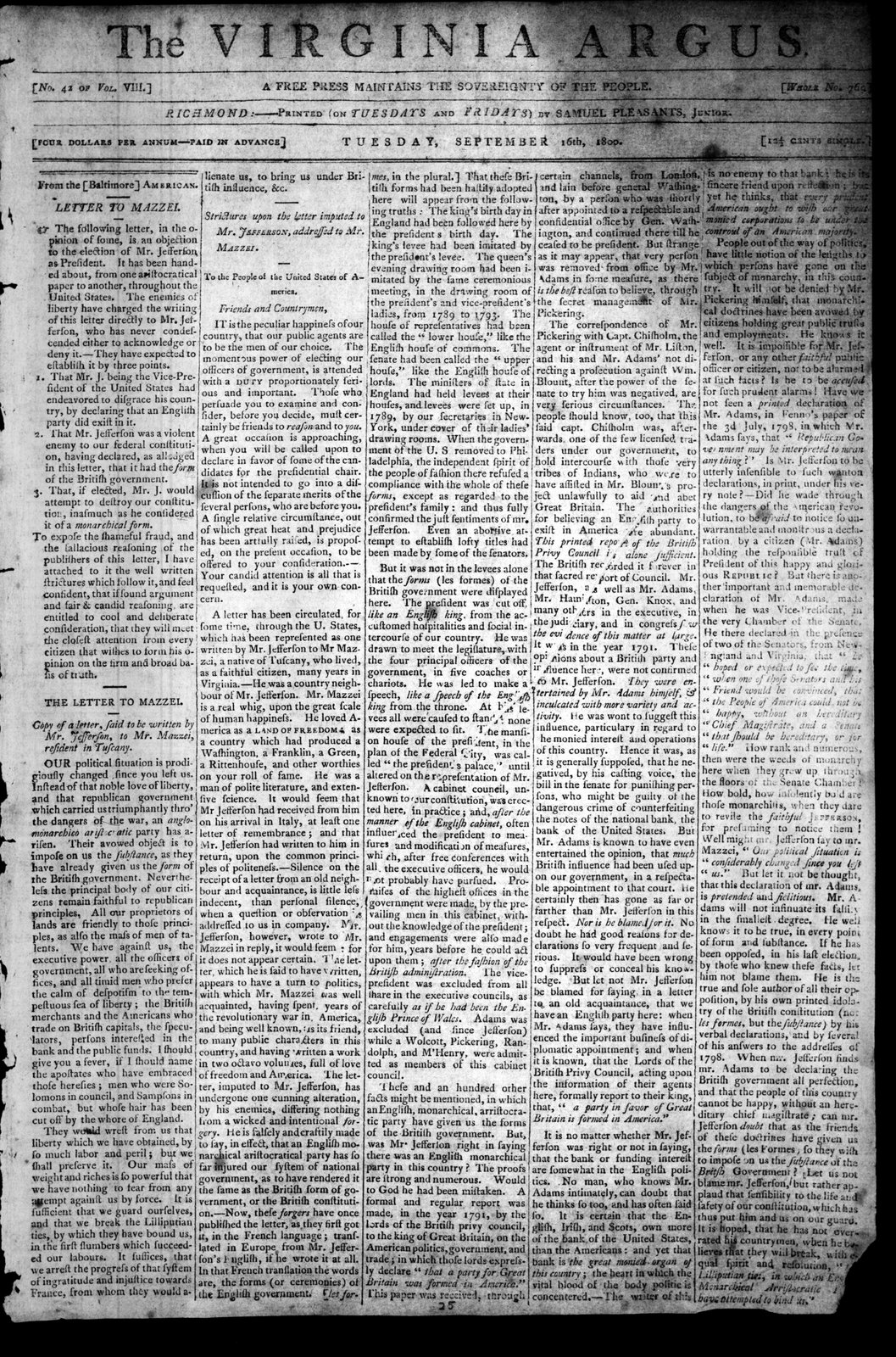
The Virginia Argus, "Letter to Mazzei" and rebuttal, 16 September 1800
The Virginia Argus answers the Mazzei charge, 16 September 1800
The Virginia Argus of 16 September 1800 reprinted the Mazzei letter with a Republican rebuttal that blamed "aristocratical" papers. Public domain.
Techniques named on the archive record
Name-callingCard stacking
Date
September 16, 1800
Made by
The Virginia Argus, Richmond (Republican newspaper), printed by Samuel Pleasants, Jr.; strictures reprinted from the Baltimore American
Medium
Newspaper pages
Country
United States
Regime
Adams Administration
Source
Identified Openly sourced: the speaker is who they say they are
Source
Internet Archive (microfilm scan, University of North Carolina at Greensboro microfilm collection) , retrieved October 2, 2026
Source
Public domain (published 1800; US public domain by publication date) The Virginia Argus, Richmond, 16 September 1800; Internet Archive microfilm scan (pub_viriginia-argus)
Object, image, and catalog record from the FRAME archive. Text on this page is CC BY 4.0. Image rights are as the archive records.
The Richmond Virginia Argus of 16 September 1800, a Republican paper printed by Samuel Pleasants, Jr., reprinted the "Letter to Mazzei" from the Baltimore American with a framing note and "strictures" in Jefferson's defense, blaming "aristocratical" papers and "the enemies of liberty" for the charge.
The page
This is the front page of a Republican newspaper in Richmond, printed on Tuesdays and Fridays by Samuel Pleasants, Jr. Under a masthead motto about a free press, it runs the "Letter to Mazzei" taken from the Baltimore American, introduced by a note and followed by "strictures" addressed to the people of the United States. The archive transcribes the masthead, the note, and the first two of its three numbered points, and stops there.
A FREE PRESS MAINTAINS THE SOVEREIGNTY OF THE PEOPLE.
[...]
LETTER TO MAZZEI.
The following letter, in the opinion of some, is an objection to the election of Mr. Jefferson as President. It has been handed about, from one aristocratical paper to another, throughout the United States. The enemies of liberty have charged the writing of this letter directly to Mr. Jefferson, who has never condescended either to acknowledge or deny it.---They have expected to establish it by three points.
1. That Mr. J. being the Vice-President of the United States had endeavored to disgrace his country, by declaring that an English party did exist in it.
2. That Mr. Jefferson was a violent enemy to our federal constitution, having declared, as alledged in this letter, that it had the form of the British government.
How it argues
The page does two things at once. It reprints the letter itself, which is a fair move: readers can judge the text for themselves. Its note also tells them in advance who is pushing the charge, "aristocratical" papers and "the enemies of liberty," so that the motive of the accuser stands in for an answer to the accusation. The archive tags the page for name-calling and card stacking. In its summary, the strictures that follow pile up the court-style ceremonies of the Washington and Adams years and quotations from Adams as proof of an "English monarchical party," with no room for the other reading.
The note also turns Jefferson's silence into dignity: he "never condescended either to acknowledge or deny it." A month earlier the Federalist side had treated the same silence as guilt.
Both papers, side by side
The Federalist half of this exchange is on this site: the Gazette of the United States of 14 August 1800, with "The Jeffersoniad" no. VIII, signed "Decius." Read together, the two pages are a fair picture of the 1800 press. Each side named the other's motives before it answered the other's facts. Neither page settles whether the letter shows what its enemies said it shows.
What matters for a free country is that both were printed, sold, and answered in public. The case study on the 1800 election covers what happened when the government stepped into that argument, and the campaign print hub follows party print through the next century.
Sources
FRAME object record, The Virginia Argus, "Letter to Mazzei" and rebuttal, 16 September 1800. The Virginia Argus, Richmond (Republican newspaper), printed by Samuel Pleasants, Jr.; strictures reprinted from the Baltimore American.
Internet Archive, microfilm scan, University of North Carolina at Greensboro microfilm collection, The Virginia Argus, 16 September 1800, retrieved by the archive 2 October 2026. Rights as recorded: public domain (published 1800).