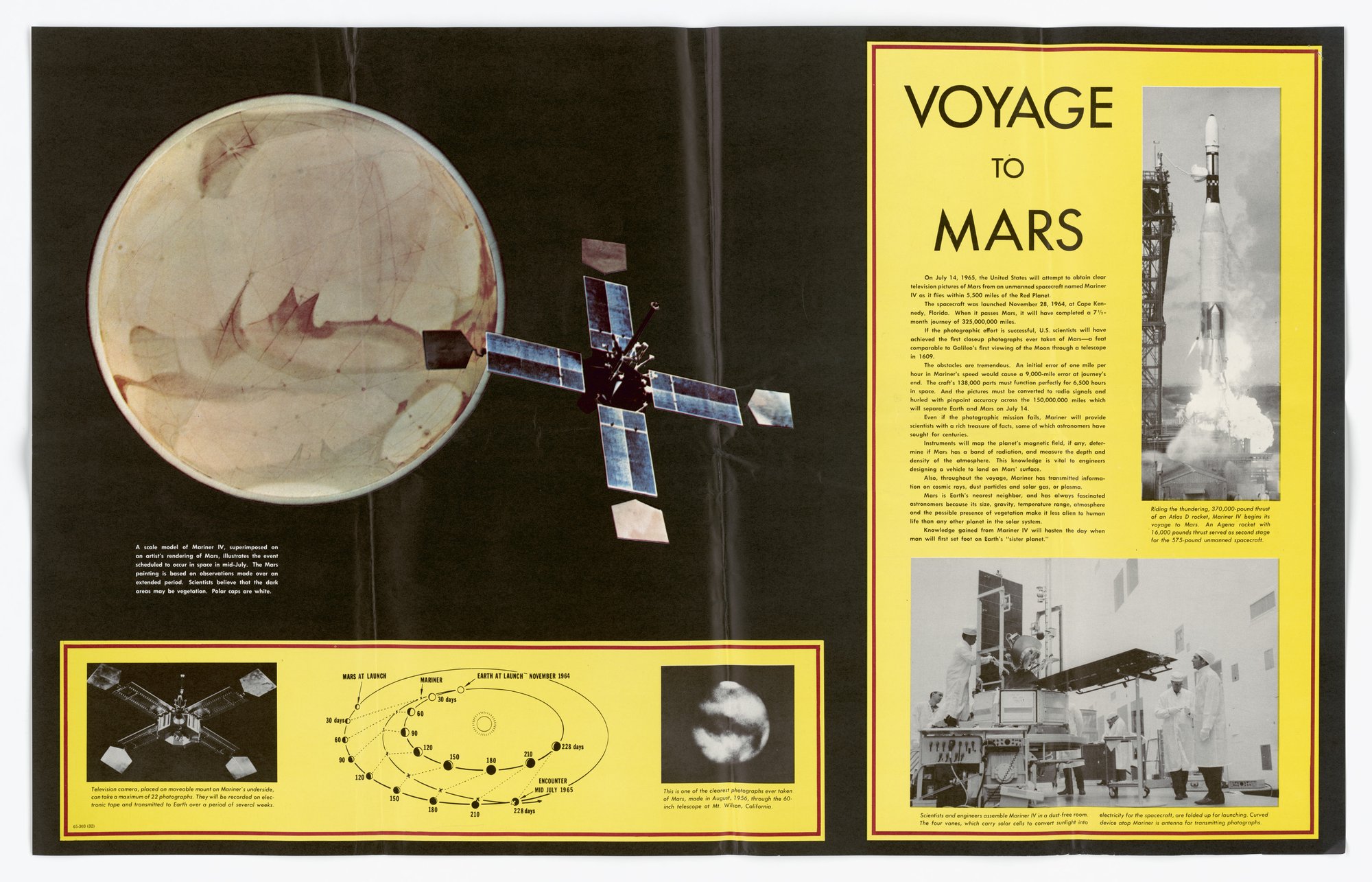
Voyage to Mars poster, English edition (English poster distributed in Beirut)
Voyage to Mars, a USIA sheet that announced Mariner IV before the flyby
A June 1965 USIA sheet for Beirut announced that Mariner IV would try to photograph Mars on 14 July, and listed what could go wrong. NAID 6949217.
Techniques named on the archive record
Card stackingGlittering generalities
Date
June 20, 1965
Made by
U.S. Information Agency (predecessor: State Department International Information and Educational Exchange Program), Propaganda Posters Distributed in Asia, Latin America and the Middle East series
U.S. National Archives (NARA), Record Group 306, Posters in Asia, Latin America, Middle East , retrieved October 4, 2026
Source
Public domain (U.S. government work; NARA RG 306) U.S. Information Agency / Department of State, June 20, 1965. National Archives, Record Group 306 (NAID 6949217, 306-PPB-293).
Object, image, and catalog record from the FRAME archive. Text on this page is CC BY 4.0. Image rights are as the archive records.
Voyage to Mars is a U.S. Information Agency display sheet dated 20 June 1965, an English edition distributed in Beirut. It tells readers that on 14 July 1965 the United States will try to take close television pictures of Mars from the unmanned Mariner IV (NAID 6949217).
What the sheet says
The archive describes a large folded display sheet. A painted Mars with a model of the probe sits on a black ground. Around a single text column are a diagram of the flight path, an older telescope photograph of the planet, a rocket launch, and technicians in clean-room gowns. The text is written in the future tense. It was printed before the encounter it describes.
VOYAGE TO MARS
On July 14, 1965, the United States will attempt to obtain clear television pictures of Mars from an unmanned spacecraft named Mariner IV as it flies within 5,500 miles of the Red Planet.
[...]
The obstacles are tremendous. An initial error of one mile per hour in Mariner's speed would cause a 9,000-mile error at journey's end.
[...]
Even if the photographic mission fails, Mariner will provide scientists with a rich treasure of facts, some of which astronomers have sought for centuries.
Who sent it, and to whom
The issuer is the U.S. Information Agency, filed in the National Archives series of posters distributed in Asia, Latin America and the Middle East. The record dates the sheet to 20 June 1965 and lists the audience as a foreign public. The catalog title calls it the English edition distributed in Beirut. The archive codes the source as unidentified: "Source blurred: contractors, cutouts, buried disclosure."
How to read it
The archive tags it card stacking and glittering generalities. In FRAME's reading, the sheet presents the mission's difficulties and goals as a national scientific effort and argues nothing else. It also compares a possible success to Galileo's first look at the Moon in 1609, which is a large claim for a probe that had not yet arrived.
What stands out is the hedge. This sheet commits in advance to a date, lists the ways the mission could miss, and says in print that the photographs might not come back. A government that announces a test before it knows the outcome is accepting the risk of being seen to fail. The record does not say how the sheet was used once the date had passed.
FRAME object record, Voyage to Mars poster, English edition (English poster distributed in Beirut), 20 June 1965. U.S. Information Agency, Propaganda Posters Distributed in Asia, Latin America and the Middle East series.
U.S. National Archives, Record Group 306, NAID 6949217 (306-PPB-293), retrieved by the archive 4 October 2026. Rights as recorded: public domain (U.S. government work).