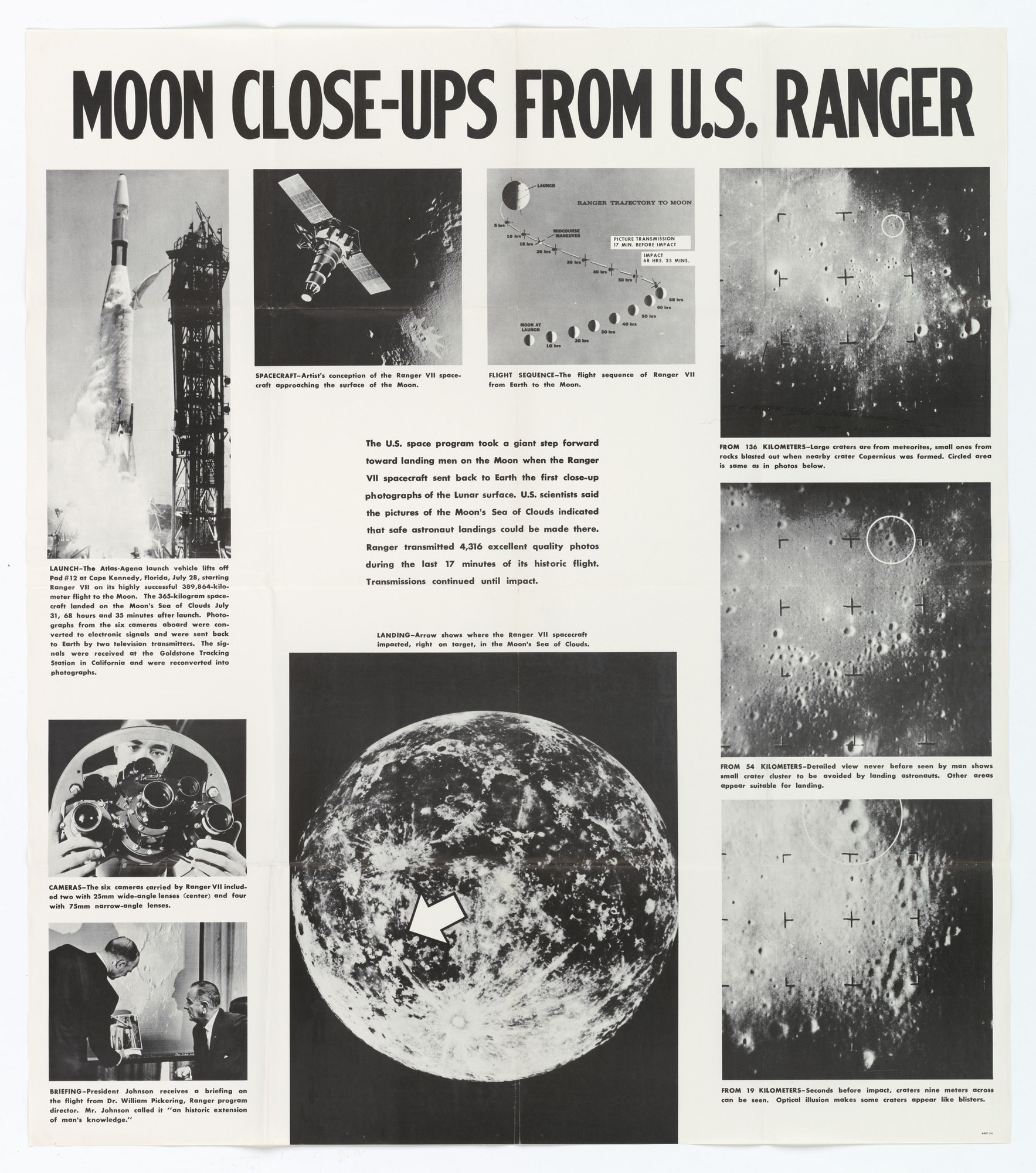
Moon Close-Ups from Ranger poster, Bangkok (English)
Moon Close-Ups from U.S. Ranger, the 1964 Bangkok photo-poster
USIA's September 1964 Bangkok photo-poster on Ranger VII: launch, flight path, Moon close-ups from 136, 54 and 19 km, and a Johnson briefing. NAID 6949263.
Techniques named on the archive record
Card stackingGlittering generalities
Date
September 8, 1964
Made by
U.S. Information Agency (predecessor: State Department International Information and Educational Exchange Program), Propaganda Posters Distributed in Asia, Latin America and the Middle East series
U.S. National Archives (NARA), Record Group 306, Posters in Asia, Latin America, Middle East , retrieved October 4, 2026
Source
Public domain (U.S. government work; NARA RG 306) U.S. Information Agency / Department of State, September 8, 1964. National Archives, Record Group 306 (NAID 6949263, 306-PPB-338).
Object, image, and catalog record from the FRAME archive. Text on this page is CC BY 4.0. Image rights are as the archive records.
Moon Close-Ups from U.S. Ranger is an English-language U.S. Information Agency photo-poster for Bangkok, dated 8 September 1964. It lays out the Ranger VII lunar flight in captioned photographs, ends with frames shot 19 kilometres above the Moon, and shows President Johnson being briefed (NAID 6949263).
The layout
The archive lists the panels: the launch, an artist's drawing of the spacecraft, a flight-path diagram, a full-Moon photograph with an arrow at the impact point, a panel on the cameras, three close-ups taken from 136, 54 and 19 kilometres, and a photograph of President Johnson receiving a briefing. Each panel has a capitalized caption heading. A central paragraph states the claim.
MOON CLOSE-UPS FROM U.S. RANGER
The U.S. space program took a giant step forward toward landing men on the Moon when the Ranger VII spacecraft sent back to Earth the first close-up photographs of the Lunar surface. U.S. scientists said the pictures of the Moon's Sea of Clouds indicated that safe astronaut landings could be made there.
[...]
BRIEFING-President Johnson receives a briefing on the flight from Dr. William Pickering, Ranger program director. Mr. Johnson called it "an historic extension of man's knowledge."
Issuer and audience
The record names the U.S. Information Agency and files the sheet in the National Archives series of posters distributed in Asia, Latin America and the Middle East. It was the English edition for Bangkok, aimed at a foreign public, with the purpose coded as persuading or winning support. The archive's source category is "Source blurred: contractors, cutouts, buried disclosure."
How to read it
FRAME tags it card stacking and glittering generalities, and says the tell is that only successes are shown, framed as national achievement. The words carry the same weight: "highly successful," "excellent quality photos," "right on target," "historic flight." Readers are given figures to check against, including 4,316 photographs in the last 17 minutes, and a flight of 68 hours and 35 minutes, but no failed flight or rival program appears anywhere on the sheet.
The President's panel matters most for how the poster works. Science is the subject, but the frame is political: a national leader is shown receiving the result, with his own words quoted. The sheet names the United States as the actor in its title and its central paragraph. It also presents a single flight as the story of a whole program.
FRAME object record, Moon Close-Ups from Ranger poster, Bangkok (English), 8 September 1964. U.S. Information Agency, Propaganda Posters Distributed in Asia, Latin America and the Middle East series.
U.S. National Archives, Record Group 306, NAID 6949263 (306-PPB-338), retrieved by the archive 4 October 2026. Rights as recorded: public domain (U.S. government work).